
TrailblazerDX 2026 ran April 15–16 in San Francisco at Moscone West, with Salesforce+ streaming for virtual attendees. The event featured 400+ technical sessions, 100+ live product demos, and a $50,000 hackathon. But the story wasn’t in the session count. The story was in what Salesforce announced — and what it signals about where this platform is heading.
Keynote Overview: Themes and Speakers
The TDX Main Keynote on April 15 (10:00–11:15 a.m. PT) centered on one thesis: building the Agentic Enterprise. Not exploring it. Not planning for it. Building it, right now, with tools you can start using today. The themes that ran through everything:
- The “Builder Gap” problem — Not everyone is moving at the same speed, and the traditional low-code admin ecosystem wasn’t front-and-center in this keynote (more on that tension below)
- Platform as infrastructure, not interface — Salesforce is APIs, MCP tools, and CLI commands first; the browser UI is now secondary
- Agents as developers — Internally, Salesforce says agents already write the vast majority of their own code
- Closing the prototype-to-production gap — The tools to build agents have existed; now Salesforce is shipping the tools to govern, test, and deploy them reliably
1. Headless 360: The Platform-Level Shift
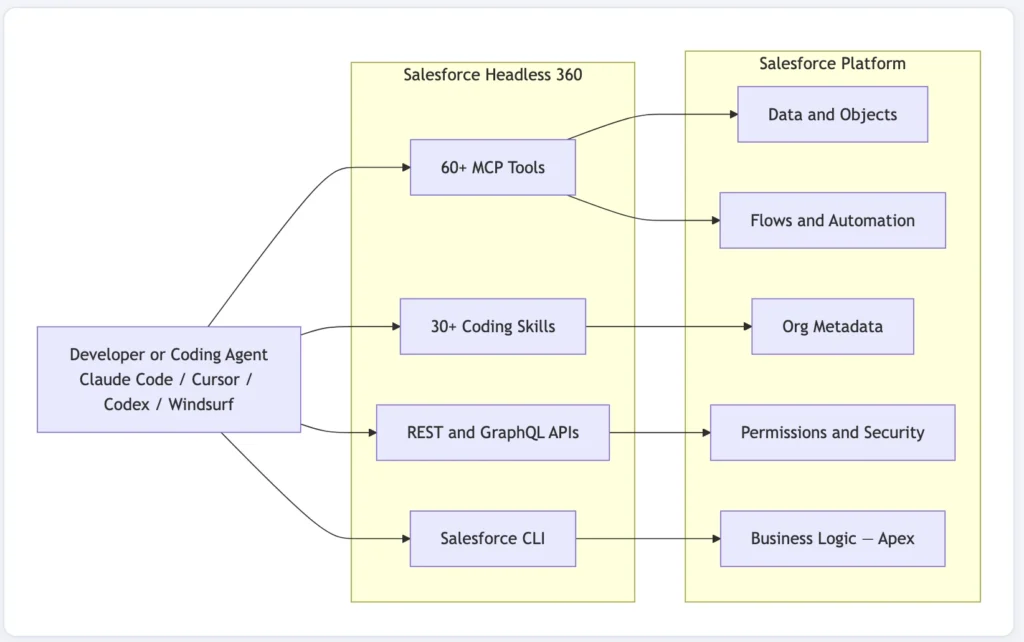
This is the headline. Salesforce Headless 360 is the company’s declaration that the entire Salesforce platform is now accessible as APIs, MCP tools, and CLI commands — callable by any coding agent, from any IDE, without ever opening a browser.
Salesforce Headless 360: No Browser Required — The Entire Platform Is Now an API.
Think about what that actually means. Every Salesforce workflow, data model, business logic layer, permission set, approval process — all of it is now surfaced as something a coding agent can discover, call, and chain together. Joe Inzerillo described it this way:
What’s Actually in the Box
- Integrations with Claude Code, Cursor, Codex, and Windsurf — bring your own coding agent
- 60+ new MCP tools giving coding agents live access to org data, workflows, metadata, and business logic
- 30+ preconfigured coding skills that understand Salesforce-specific development patterns
- Native React support for developers building custom front-end interfaces outside the Salesforce UI
2. Agentforce Vibes 2.0: Your New Free IDE
If Headless 360 is the infrastructure announcement, Agentforce Vibes 2.0 is the one developers can touch today. The original Agentforce Vibes dropped just before Dreamforce ’25. Vibes 2.0 is a significant upgrade. Here’s what changed:
- Multi-model support. The default LLM is now Claude Sonnet 4.5, but you can switch to GPT-5 or Salesforce’s own models. If you’ve been frustrated with single-model lock-in in AI coding tools, this matters.
- Org metadata awareness. Vibes 2.0 understands your org’s schema, existing code patterns, and business context. It’s not just a generic code generator — it knows what
OpportunityLineItemmeans in your specific configuration. - Two operating modes: Plan mode (proposes changes before executing) and Act mode (executes directly). Working in a sandbox? Act mode is fast. Close to production? Plan mode saves you from surprises.
- Build loop improvement. Salesforce claims the build cycle is up to 40% faster. I’d treat that number with healthy skepticism until your own benchmarks validate it, but the reduction in context-switching between tools is real.
Free Developer Edition Access (With a Catch)
Here’s the part worth reading carefully. Every Developer Edition org now includes:
- Agentforce Vibes IDE (browser-based, VS Code-based, zero setup)
- Claude Sonnet 4.5 as default coding model
- Salesforce Hosted MCP Servers
Agentforce Labs Quickstart gets you instant Agentforce access from your own IDE — no org provisioning, no setup screens. Connect and start building in Claude Code, Codex, or Agentforce Code in minutes, not hours.
3. Agent Script Goes Open Source
This one surprised me. Agent Script — Salesforce’s structured definition language for agents — is now open source, with the full language specification, grammar, parser, and compiler available at github.com/salesforce/agentscript.
What is Agent Script, for those just meeting it? It’s a typed, structured language where you define an agent’s behavior: when it uses LLM reasoning, when it follows deterministic logic, what subagents it can call, what variables it tracks, what guardrails constrain it. Think of it as Infrastructure as Code, but for agent behavior.
The open sourcing matters for several reasons:
- IDE tooling catches problems before they cost you. Developers now author and validate
.agentfiles locally, run LLM-powered safety reviews that catch harmful patterns keyword filters would miss, and deploy without leaving their IDE. - Production traces feed back into authoring. The ADLC skills close the loop — production session traces inform future iterations of your
.agentfiles. - Text and voice channels. Agent Script now works across both. Same deterministic control over voice interactions as text. That’s a big deal for any contact center implementation.
- Agents building agents. The open spec means the language itself can be understood by other AI systems.
4. Agentforce Experience Layer (AXL)
The problem AXL solves is one every team building agents has hit: you build a great agent, it works perfectly in your web UI, and then you have to rebuild the entire interaction layer for Slack, then for mobile, then again for voice. Every surface, from scratch.
AXL’s answer is build once, render everywhere. You define interactive components — flight status cards, rebooking workflows, decision tiles, data layouts — and AXL renders them natively across:
| Surface | AXL Renders Natively? |
|---|---|
| Slack | Yes |
| Salesforce Mobile | Yes |
| ChatGPT | Yes |
| Claude | Yes |
| Google Gemini | Yes |
| Microsoft Teams | Yes |
| Any MCP-compatible client | Yes |
The architectural implication: agent logic and agent presentation are now decoupled. You can evolve one without touching the other. If you’ve worked on any project where a UI change required re-testing 14 agent scripts, you’ll appreciate this.
5. AgentExchange: One Marketplace to Rule Them All
AgentExchange is Salesforce’s consolidation of three separate marketplaces into one governed storefront:
| Previously Separate | Now Part of AgentExchange |
|---|---|
| AppExchange (Salesforce apps) | 10,000+ Salesforce apps |
| Slack Marketplace | 2,600+ Slack apps |
| Agentforce ecosystem | 1,000+ agents, tools, MCP servers |
13,000+ total listings. Partners include Google, DocuSign, Notion, and many others. Discovery is AI-guided — describe what you need and the system surfaces relevant options. Activation is one click.
6. Slack Becomes the Front Door
Parker Harris called Slack “the front door to the agentic enterprise.” At TDX 2026, Salesforce backed that framing with product.
- Slackbot as MCP client. The conversational Slackbot now orchestrates work across Agentforce agents, 2,600+ Slack Marketplace apps, and 6,000+ AppExchange applications — all through a single conversation thread. AI agents on Slack have grown by 300% since January 2026, according to Salesforce data.
- CRM-in-Slack. Native CRM capabilities embedded directly into Slack, removing implementation overhead for smaller businesses.
- Slack Agent Kit. A new collection of tools for bringing agents from any platform into Slack with a chat UI. If you’ve built agents on non-Salesforce infrastructure, the Slack Agent Kit is how you surface them in Slack without rebuilding your backend.
- Project Albert (preview). Salesforce disclosed early work on an enterprise-grade local agent for autonomous desktop interaction within Slack and across Salesforce applications. This is the first public signal that Salesforce is treating local agents as a formal product category. No GA date announced — treat this as a directional preview only.
Your Action Items This Week
- Activate a Developer Edition org and spin up Agentforce Vibes 2.0 — 15 minutes, zero setup
- Star the agentscript GitHub repo and read the language spec
- Review the ADLC skills repo if you’re doing any agent deployment work
- Watch the TDX Main Keynote on Salesforce+ if you missed it live
- Check whether your current AppExchange apps appear in AgentExchange — your ISV strategy may need updating