
There is a version of this story where Slack never exists. A game shuts down. The studio burns through its runway. The team scatters. The internal messaging tool they built to stay coordinated across Vancouver, San Francisco, and New York quietly disappears with everything else. Stewart Butterfield moves on to something else entirely.
That is not what happened. And the reason it did not happen is one of the more instructive accidents in the history of enterprise software.
Born from Failure, Not Vision
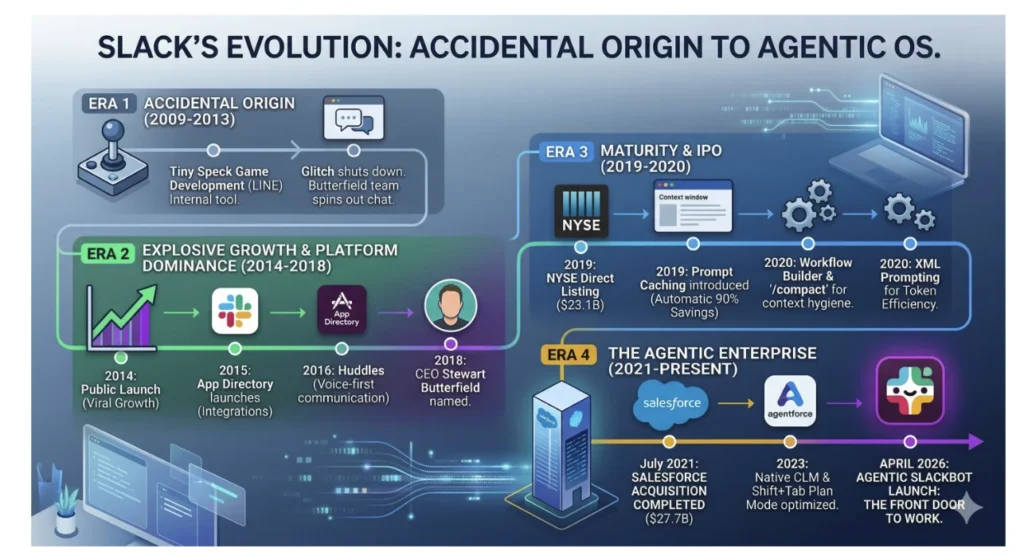
In 2009, Butterfield — already known for co-founding Flickr before selling it to Yahoo — started Tiny Speck, a gaming studio backed by $1.5 million in seed funding. The goal was an online multiplayer game called Glitch: cooperative, non-violent, genuinely strange. They raised more money. They built for three years. They launched in September 2011, iterated hard, and then shut the whole thing down in late 2012.
What they did not shut down was the internal tool they had built to keep a distributed team functional. The tool had no grand architecture behind it. It existed because they needed it. Developers in different time zones needed to stop digging through email chains to find decisions that had already been made. So they built something searchable, threaded, and channel-based. Exactly what they needed. Nothing more.
When Glitch died, about $5 million remained in the bank. Butterfield looked at what the team could not stop using and asked whether anyone outside Tiny Speck would want it. They named the product Slack, which Butterfield said stood for Searchable Log of All Conversation and Knowledge. That name was doing a lot of work. It told you exactly what the product solved.
A closed preview launched in August 2013. Eight thousand companies signed up in a single day. Within two weeks: 15,000. The public release followed in February 2014. In three days, the platform generated $1 million in subscriptions. Nobody was running ads. It spread by word of mouth inside companies, often without IT department approval, because it was just that much better than email.
The Climb to $28 Billion
By 2015, Slack was a unicorn. By 2019, it was a public company — not through a traditional IPO but through a direct listing on the New York Stock Exchange, trading under the ticker WORK. On day one, the market valued it at roughly $19.5 billion.
The growth was real but it was not painless. Microsoft had been watching. Teams, launched in 2017 and bundled into Office 365 subscriptions that enterprises were already paying for, started eating into Slack’s territory. By late 2020, Teams had 115 million daily active users. Slack had 12 million. The gap was uncomfortable.
That context matters for what happened next. In December 2020, Salesforce announced it was acquiring Slack for $27.7 billion — the largest acquisition in Salesforce’s history, representing a 54% premium over Slack’s market cap at the time. Marc Benioff called it “a match made in heaven.” The deal closed in July 2021.
The strategic logic was clear enough. Salesforce was sitting on the world’s largest CRM platform, touching every customer-facing workflow in the enterprise. Slack sat at the center of how teams communicated. Together, they could build something that neither could alone: a digital headquarters where CRM data, team communication, and business processes lived in the same place.
Whether that vision has fully materialized is a fair debate. But what happened to Slackbot in the years since is not ambiguous at all.
What Slackbot Was, and What It Is Becoming
For most of its life, Slackbot was polite and mostly harmless. It welcomed you to workspaces. It answered basic questions about Slack features. It ran simple automated responses you could configure yourself. Useful, occasionally charming, largely forgettable.
That started to change in 2023 when Salesforce began pushing generative AI capabilities into the platform. Channel recaps appeared. Thread summaries arrived. Search got smarter, letting you ask questions in natural language instead of guessing keywords. Not transformative individually, but a clear signal of direction.
January 2025 brought a more substantive update. Slackbot gained what Salesforce described as agentic capabilities: it could draft emails, schedule meetings, and sift through inboxes for specific information. Useful, but still within a familiar range of what an AI assistant does.
Then, on March 31, 2026, Salesforce CEO Marc Benioff unveiled 30 new AI features for Slack at a private event in San Francisco. What he announced was not an incremental update.
The Slack AI Revolution: 30 New Features
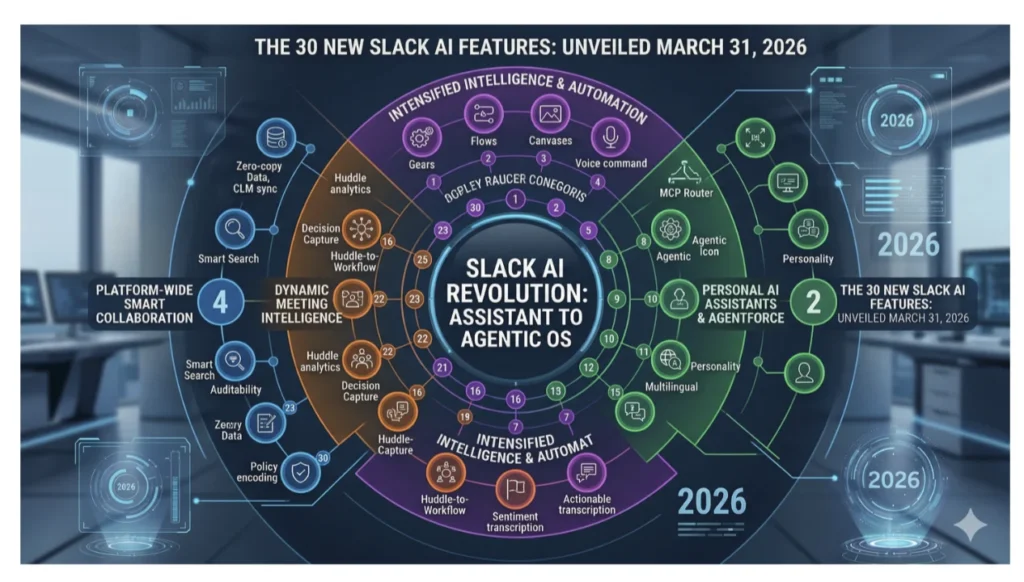
I. Intelligent Workflows & Automation (7 Features)
This category focuses on moving beyond chat into direct action and automation, effectively making Slack the primary interface for work.
- Direct-to-Action API: Users can create and trigger custom API calls to external systems via natural language chat.
- Autonomous CRM Sync: The entire Salesforce pipeline can be managed and updated without leaving Slack.
- Cross-App Automation Chains: Slackbot can connect multi-step actions across apps, like detecting an IT issue, creating a Jira ticket, and alerting the correct on-call team.
- No-Code Smart Flows: The Workflow Builder is infused with predictive logic, suggesting the optimal next steps based on historical data.
- Voice-Activated Automation: Execute complex workflows by speaking commands in a Slack Huddle.
- Reusable AI Skills: Define business best practices as codable AI skills that Slackbot can deploy whenever it detects relevant conversation.
- Auto-Updating Canvases: Canvases can be linked directly to CRM records, automatically populating with real-time deal or case summaries.
II. Personal AI Assistants: Agentforce for Slack (8 Features)
This category integrates Salesforce’s advanced agentic logic directly into Slack, creating personalized, proactive teammates.
- Model Context Protocol (MCP) Router: Slackbot acts as a universal router, pulling data from Agentforce, Data Cloud, or custom LLMs to execute tasks.
- Proactive Desktop Awareness: With strict user permission, Slackbot can monitor real-time desktop activity and offer contextual assistance.
- Custom Skill Orchestration: Define boundaries and tools for specialized agents, transforming standard users into Agent Orchestrators.
- Persistent Memory Layer: Slackbot learns individual user work patterns, shortcuts, and key stakeholders to personalize assistance over time.
- Context-Aware Briefings: Request a personalized briefing canvas that summarizes data across emails, previous chats, and documents for an upcoming meeting.
- Headless CRM Interaction: Small businesses can manage simple CRM tasks directly via voice/text, skipping the full Salesforce UI.
- Prompt Engineering is the New Apex: Define boundaries and metadata grounding for agents via structured prompt engineering, not just code.
- Multilingual Agentic Reasoning: Agents can understand, reason, and act in multiple languages seamlessly.
III. Dynamic Meeting Intelligence (7 Features)
Transforming Huddles and meetings from mere discussions into automated decision-logging and action-taking engines.
- Autonomous Action Item Resolution: Meeting decisions are captured and immediately converted into actionable tasks in external systems.
- Real-Time Huddle Analytics: Analyze the flow of conversation in a Huddle, highlighting key decisions and sentiment.
- Sentiment-Based Recaps: Transcriptions and summaries automatically flag positive sentiment, concerns, and pivotal agreement moments.
- Automated Follow-Through Engine: Slackbot can own a meeting’s action list, automatically following up with relevant owners until tasks are complete.
- Proactive Meeting Scheduling: Slackbot scans calendars and availability to suggest optimal meeting times and create the calendar invite instantly.
- Visual Meeting Canvases: Meeting recaps are automatically laid out in a clean, visual canvas, complete with key graphics or code samples discussed.
- Huddle-to-Workflow Conversion: With one click, convert a key Huddle outcome into a reusable automated workflow.
IV. Platform-Wide Smart Collaboration (8 Features)
General enhancements to the Slack environment that reduce context-switching and optimize productivity.
- Universal Data Mounting (Zero-Copy): View and reference data from external sources like Snowflake or BigQuery directly in Slack, with zero replication.
- AI-Ready Metadata Strategy: Define key metrics once, and Slackbot uses that single definition across all reasoning tasks.
- Context Window Hygiene Tools: Manage conversation history with tools like /clear and custom compaction rules.
- Native CLM Management: Vetted suppliers and documents in your CLM can be referenced and summarized instantly via Slackbot.
- Structured XML Prompting: Experts can interact with the agentic layer using XML tags to reduce ambiguity and rework.
- Cross-Channel Knowledge Graph: Slackbot can connect insights from conversation threads and document types across different channels.
- Smart Search Overhaul: Search queries can be posed as complex, multi-variable questions across all connected data.
- AI Exclusion Controls: Implement robust permissions to exclude sensitive channels, data types, or regions from the AI’s reasoning context.
The 30-Feature Overhaul: What Actually Changed
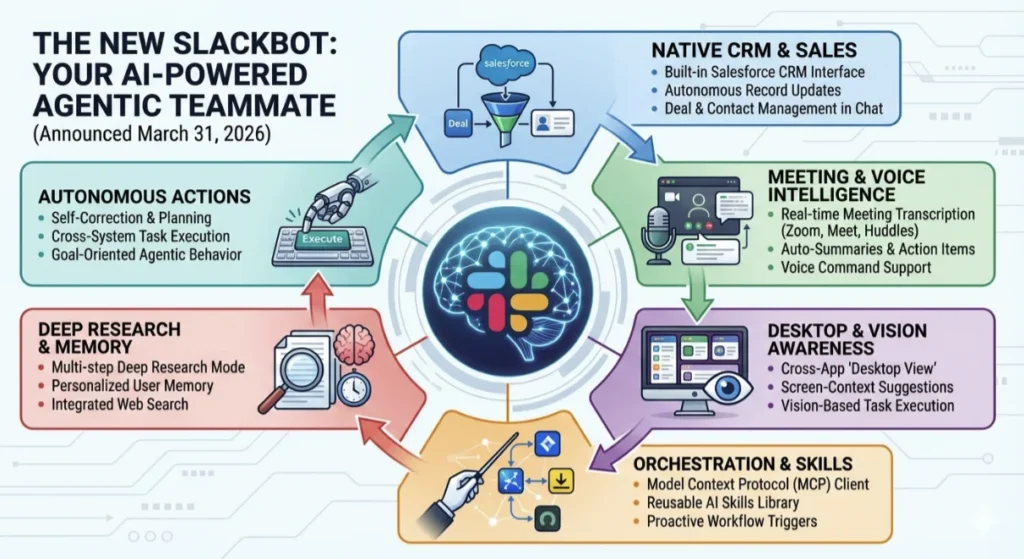
The centerpiece of the March 2026 announcement is something Salesforce calls reusable AI skills. The concept is worth sitting with because it is genuinely different from how most AI assistants work.
A skill is not a one-time prompt. You define a task once — the inputs, the steps, the exact output format — and Slackbot can apply that definition automatically any time a matching request comes in. Salesforce ships a library of built-in skills covering common workflows: campaign briefs, pipeline summaries, incident reports. Teams can also build their own.
Here is the part that matters operationally: Slackbot recognizes when your request matches an existing skill and applies it without you invoking it manually. What one person builds becomes the default for everyone. For organizations that spend real money on workflow automation platforms and the IT support required to run them, this is a significant cost calculus shift.
The second major capability is Slackbot’s new role as a Model Context Protocol (MCP) client. MCP is a protocol that lets AI agents connect and coordinate with external services. Slackbot can now integrate with Agentforce — Salesforce’s AI agent development platform launched in 2024 — which means it can route tasks and questions to any specialized enterprise agent without requiring human intervention. Rob Seaman, Slack’s interim CEO, put it simply: the agent finds the most efficient path for the information.
This creates a federated architecture. Slackbot is the conductor. Agentforce agents are the specialists. You ask a question. Slackbot determines which agent or system is best equipped to answer it. You get a result. The routing happens invisibly. And it extends beyond Salesforce — Slackbot can coordinate with the 2,600-plus apps in the Slack Marketplace and the 6,000-plus in the Salesforce AppExchange. Google Workspace, Microsoft 365, Notion, Workday, ServiceNow — all reachable through the same conversational interface.
The third capability that stands out: Slackbot can now operate outside of Slack itself. It monitors desktop activity — calendars, deal pipelines, communication patterns, habits — and generates proactive suggestions and follow-up drafts based on that context. It transcribes meetings, captures decisions, logs action items, and because it is natively connected to Salesforce, updates CRM opportunities and creates follow-up tasks automatically at the end of a call.
Salesforce reports that teams inside the company using these capabilities are saving up to 20 hours per week, generating over $6.4 million in productivity value. Some employees report 90 minutes saved daily — roughly two months of working hours recovered per year.
The Revenue Picture
Slack generated $902 million in revenue in fiscal year 2022, its first full year under Salesforce, and crossed $1.5 billion in 2023. By the second quarter of fiscal 2023, Slack accounted for 12% of total Salesforce revenue. As of 2025, growth had decelerated from 46% year-over-year in Q3 FY2023 to approximately 19% in Q3 FY2025 — still growth, but the kind of number that raises questions about headroom.
The answer Salesforce is betting on is AI monetization. Slack AI is available as an add-on, not bundled into base plans. The directional strategy is clear: use AI features to increase average revenue per seat, deepen stickiness, and justify higher contract values with quantifiable productivity ROI. The $6.4 million in internal productivity savings is not an accident — it is the enterprise sales pitch made concrete.
Slack’s overall market position remains strong. It holds roughly 34% market share in the enterprise communication category. Over 100,000 organizations use the platform. The Fortune 100 penetration rate exceeds 80%. The customer base is entrenched. The question is always whether Microsoft Teams, which continues to benefit from bundling in M365, can convert that entrenchment into churn. So far, for Slack’s enterprise tier, the answer has largely been no.
What This Means for Different Teams
Sales teams are the clearest immediate beneficiaries. Meeting transcription connected to CRM, automatic opportunity updates, follow-up drafts generated in context — this addresses the part of a sales rep’s day that has nothing to do with selling. If a rep is spending six to eight hours per week on post-call data entry, that is recoverable time.
IT and engineering teams get the MCP integration angle. Slackbot as an orchestration layer means AI capabilities from multiple systems are accessible through a single interface without building custom integrations for each. ServiceNow incidents, Jira tickets, Workday approvals — all reachable from the channel where the team already works.
Operations and finance teams get the skill-based automation. Budget creation, procurement summaries, headcount reports — define it once, run it on demand, with Slackbot pulling from every connected data source automatically.
Small businesses get something more surprising: a native CRM. Slackbot now reads channels, understands customer conversations, and keeps deals and contacts updated automatically, without a separate system. That is a direct play into the SMB market that Salesforce has historically under-served.
The Competitive Reality
Slackbot’s evolution does not happen in a vacuum. Microsoft Copilot is embedded across Teams, Office, and the broader M365 surface area. Google Gemini is doing similar things in Workspace. Both are operating from massive installed bases with similar bundling advantages.
What Slack has that neither of them does is depth of CRM integration. Salesforce’s customer data, pipeline intelligence, and workflow automation live natively in the same ecosystem. For companies already running Salesforce — and that is most of the Fortune 500 — Slackbot’s context awareness is materially different from what a Copilot or Gemini can offer. It already knows your deals, your accounts, your open tasks. It is not inferring that context from email metadata. It has it.
The risk is that this advantage matters most to existing Salesforce customers and less to everyone else. Slack’s long-term growth trajectory depends on whether the AI layer can attract new organizations that would not otherwise have chosen the platform. The MCP architecture is a reasonable answer to that question — interoperability means you do not need to be all-in on Salesforce to get significant value from Slackbot.
Where This Goes
The collaboration software market is projected to exceed $70 billion by 2027. Slackbot’s development path suggests Salesforce sees it not as a feature within a communication tool, but as the primary interface through which enterprise workers will interact with every AI system their organization deploys.
That is a different claim than “better chat.” It is the claim that Slack becomes the operating system for how work gets done — the layer through which you instruct, receive, and act on information from any system in your stack. Whether that materializes depends on adoption, on how cleanly the MCP integrations actually work at scale, and on whether the productivity gains hold up outside of Salesforce’s internal measurements.
Stewart Butterfield left Slack in early 2023. The company he built from the wreckage of a failed game is now something he probably could not have anticipated when he was describing the pivot in a Vancouver office in late 2012. What started as a way to keep a small team from losing things in email threads is, 13 years later, being positioned as the AI backbone of the modern enterprise.
That trajectory is either inspiring or alarming, depending on where you sit. What it is not is boring.
About the Author
Eshaan Jain serves as a Senior Product Manager at Mphasis, focusing on Revenue Operations and AI and CPQ transformations across Enterprise, Government, and Education sectors. He designs and implements Quote-to-Contract (Q2C) and Contract Lifecycle Management (CLM) platforms. Eshaan earned his MS in Computer Science from the University of Southern California and has over 13 years of experience with enterprise systems at organizations like Amazon, PwC, and Accenture. He has published research on mobile cloud computing architectures and Artificial Intelligence in leading journals such as IEEE and Elsevier and holds multiple Salesforce certifications.