
During a recent discovery workshop with the CPQ/Revenue Cloud team at a leading cloud infrastructure provider, one theme kept coming up. Their challenge was straightforward: the out-of-the-box Revenue Cloud quoting UI didn’t fit how their sales and finance teams actually worked, and they were tired of adapting their process to fit the screen instead of the other way around.
For the last several years, the default answer has been to go headless: strip off the standard UI, build whatever quoting experience you want, and call the platform through its APIs. So I raised that option in the room. The response from the Salesforce product team surprised me. They weren’t pointing us toward “build your own UI and call our APIs.” Instead, they described what they called “Headless 360” — a model where the client’s own UI, or increasingly an Agentforce agent, gets access to CPQ/Revenue Cloud data, security, and business processes without rebuilding that logic client-side.
On the surface, “headless” and “expose everything through APIs” sound like the same idea. They aren’t. And the gap between them matters a lot more once the thing asking for a quote isn’t a custom app at all, but an agent.
What Headless 360 means here
“Headless 360” is not an industry-standard term. I’m using it here to describe the architectural direction I’ve been discussing with Salesforce product teams: a model where the platform exposes governed data, security, and business logic together, rather than leaving all of that to the calling app.
A simple architecture view
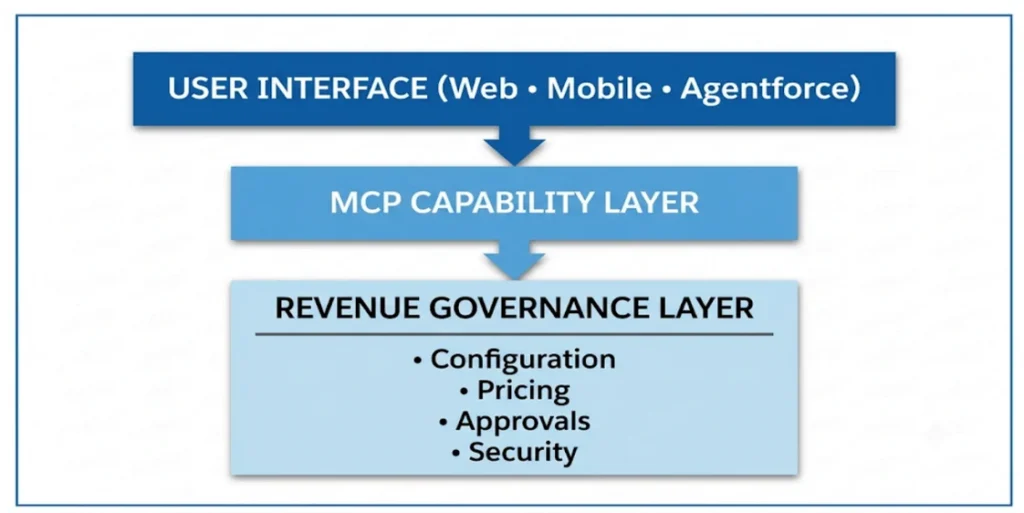
The diagram above is intentionally simple. The point is not the number of components, but the shift in responsibility: the caller asks for the outcome, and the platform handles the guardrails underneath.
What headless has meant for CPQ
Most Salesforce architects have built headless CPQ the same way for years: strip out the standard quoting UI, stand up a custom front end, and wire it to Revenue Cloud through REST or SOAP APIs, Apex REST endpoints, or a middleware layer.
That works, but look at what it actually requires:
- The quoting app has to know which endpoint does what: configuration, pricing, discount, approval.
- The app owns orchestration, sequencing, and routing itself.
- Discount ceilings and approval policy get re-implemented in the client’s own code, since an API only hands back data, not the policy behind it.
- Every new front end — web app, mobile app, partner portal — reimplements this integration logic from scratch.
In other words, headless was really just the UI. Everything underneath was still classic
point-to-point API integration: one operation per call, with the calling app responsible for stitching those operations into an actual quote-to-cash process.
Where Headless 360 changes the picture
Headless 360 isn’t about giving a quoting app a wider set of endpoints to call. It’s about exposing Revenue Cloud’s data, security model, and pricing and approval logic as one governed package, instead of individual operations the client assembles on its own.
- Data — not just product and price fields, but the configuration rules, discount history, and approval precedent built into the org.
- Security — sharing rules, field-level security, and permission sets enforced at the point of access, not re-implemented by whatever’s calling in.
- Process — the pricing and approval logic itself, executed by the platform, not re-derived by the client.
That’s a bigger promise than “here’s an API.” An API hands you an operation. Headless 360 hands you the outcome of that operation, governed the same way it would be if a rep were clicking through the standard quoting UI.
Where Agentforce and MCP fit
This is where the architectural distinction becomes practical. In the implementations I’ve been involved with, MCP is becoming the mechanism that enables this model for Agentforce agents. Instead of an agent needing a custom integration to look up a discount limit or check configuration compatibility, an MCP server exposes that capability directly — with Revenue Cloud’s own security and pricing logic doing the enforcement, not code an integration team wrote and now maintains.
The practical shift is straightforward: the thing asking for a quote is no longer only a
custom-coded app. It can be an Agentforce agent, reasoning in natural language, discovering what it’s allowed to do, and calling it — while every guardrail the org has spent years building stays intact underneath.
The same quote, two ways
It’s easier to see the difference with one scenario: a SaaS sales rep needs a quote for 200 seats configured, priced, and routed for approval.
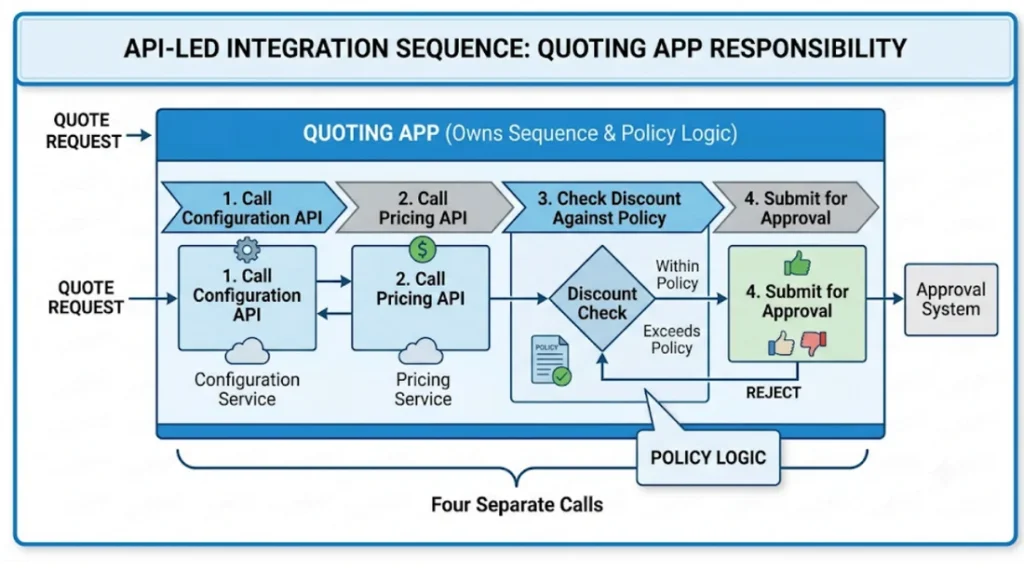
The front end orchestrates each step separately in an API-led model
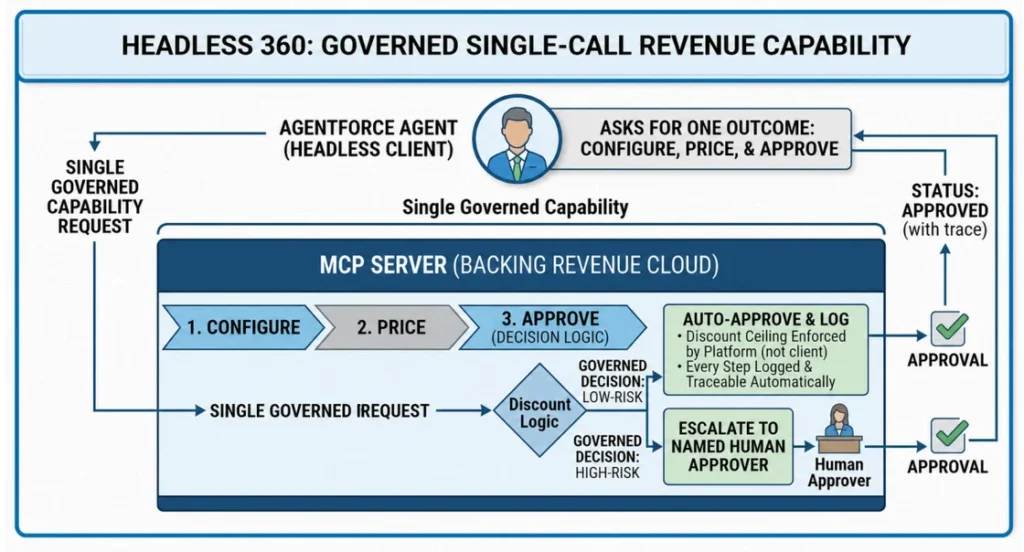
Headless 360 lets the platform govern the workflow through a single controlled
capability.
Headless 360 vs. API-led integration
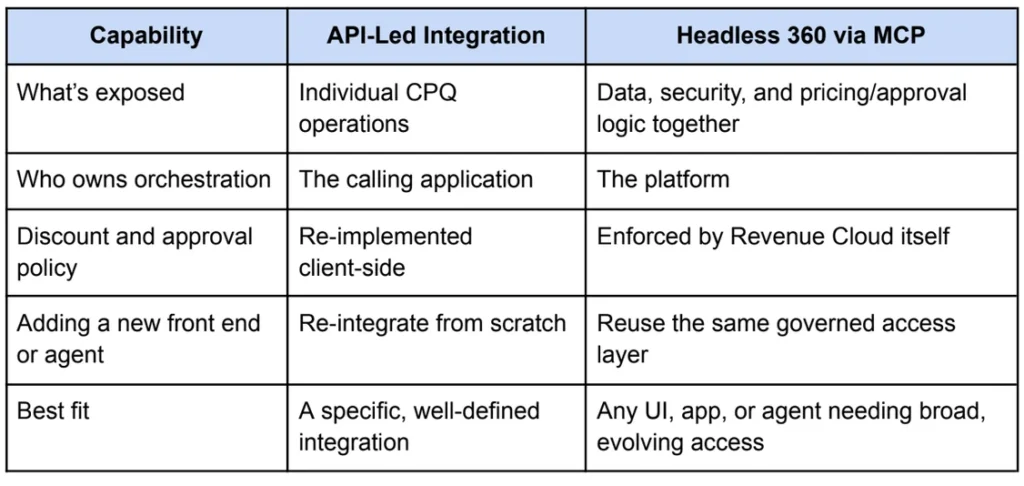
The important distinction isn’t that one approach replaces the other—it’s that they optimize for different architectural goals.
Why does this matter now? Because the primary consumer of enterprise business capabilities is changing. Historically, integrations were designed for applications. Increasingly, they’re being designed for AI agents that discover capabilities dynamically, reason over business context, and require governance to be enforced consistently. That shift fundamentally changes what “headless” should mean for enterprise architects.
What this means for architects
This doesn’t make API-led integration obsolete. Plenty of narrow, well-defined CPQ integrations are exactly where a lightweight API call is the right tool, and routing a simple, single-purpose integration through an MCP layer is over-engineering it.
But where the caller needs broad, evolving access to your quote-to-cash process — an internal tool, a partner-facing app, or increasingly an Agentforce agent — Headless 360 is a different architectural decision than “expose some endpoints,” and it deserves to be treated as one rather than a default.
Worth raising with your architecture team before you commit to either path:
- Does the caller need one specific CPQ operation, or ongoing access to configuration, pricing, and approval as a whole?
- Who is responsible for enforcing discount ceilings and approval policy — your integration code, or Revenue Cloud itself?
- If the caller today is a custom app, could it be an Agentforce agent tomorrow — and does your integration approach survive that shift without a rebuild?
Key takeaways
- Headless 360 is my shorthand for an emerging Salesforce architectural direction, not a formal industry term.
- The main shift is from client-owned orchestration to platform-governed capabilities.
- MCP matters because it lets agents reach Revenue Cloud without recreating policy logic in every front end.
- API-led integration still has a place for narrow use cases, but it is not the same thing as governed headless access.
Takeaway
“Headless” and “API-led” have been treated as roughly interchangeable for years, and for most of that time the difference didn’t matter much in practice. It matters now.
Headless 360, delivered through MCP, hands a CPQ or Revenue Cloud process over as a governed whole — data, security, and pricing logic together — rather than an endpoint and an instruction to figure out the rest. As more of what asks for a quote is an Agentforce agent rather than a hand-built integration, that distinction is becoming one of the defining architectural decisions for modern Salesforce implementations.