
Salesforce spent twenty-five years teaching the world that work happens inside its tabs. On Tuesday it announced a product whose selling point is that you might never open one again. Join us to learn about What Salesforce + Anthropic Actually Ship.
That’s Claudeforce — the expanded Salesforce–Anthropic partnership announced 26 August 2026, on the same day Salesforce reported Q2 FY27 earnings. It runs in two directions at once: Claude moves into Salesforce as a reasoning model, and Salesforce moves into Claude as a plugin with 37 prebuilt sales skills. Patrick Stokes, Salesforce’s President of Applications & Marketing, put the strategic bet plainly: “When people stop using Salesforce through the traditional human interface and start using it through an agentic interface, it dramatically increases the value of Salesforce.”
That’s a genuinely strange thing for a UI company to say out loud. It’s also the most interesting part of this announcement.
What you’ll get from this post: what Claudeforce actually includes (versus what’s marketing framing), the architecture underneath it, the permission model that decides whether this is safe in your org, the real timelines, and a concrete decision framework for whether to pilot it.
Who this is for: Salesforce Admins and Architects first, with developer notes where the MCP plumbing matters. If you’ve already set up a Hosted MCP Server, you’ll recognize about 70% of the machinery here.
What is Claudeforce?
Claudeforce is the expanded strategic partnership between Salesforce and Anthropic, announced 26 August 2026. It embeds Claude as a reasoning model across Salesforce products and embeds Salesforce inside Claude as a plugin with 37 prebuilt sales skills.
The Salesforce in Claude plugin is with select pilot customers, with open beta expected September 2026. Claude’s availability inside Agentforce surfaces (Atlas, Vibes, Coworker, Agent Builder) is live now
Background: Why Salesforce + Anthropic Partnership Exists Now
Claudeforce didn’t come out of nowhere. It’s the commercial packaging of an architecture Salesforce shipped four months earlier.
In April 2026, Salesforce announced Headless 360 — the initiative that exposed the platform’s capabilities as APIs, MCP tools, and CLI commands rather than screens. (We covered the hands-on setup in Salesforce Headless 360 Hands-On.) The Hosted MCP Servers went to Beta in July 2026. So the pipes were already laid.
What was missing was scale. Stokes described the problem directly: after TDX 2026, developers started building agent interfaces against those MCP servers and immediately hit a wall — managing authentication, enforcing permissions across a hundred-plus users, governing the whole thing. Every team was solving the same plumbing problem badly, one user at a time.
Claudeforce’s real product insight is administrative, not intelligent. One admin connects the org once. Everybody gets access, scoped to their own permissions. That’s it. That’s the unlock.
Deep Dive: What Claudeforce Actually Contains
Claudeforce is an umbrella name over three distinct workstreams. Keep them separate in your head, because they have different maturity levels, different buyers, and very different risk profiles.
1. Claude in Salesforce
First, a framing correction that most launch coverage skipped: Claude didn’t arrive in Agentforce this week. It’s been a foundation model inside Agentforce since late 2025. Claudeforce deepened and formalized an existing relationship — it didn’t create one. If you’ve been running Agent Builder with Claude selected for months, nothing about your setup just changed.
What Claudeforce does is make that placement official across four specific surfaces:
| Surface | What Claude does there | Status |
|---|---|---|
| Atlas Reasoning Engine | Available as a reasoning model powering agent plan-and-act loops | Available |
| Agentforce Vibes | Default model in the Vibes IDE | Default |
| Agentforce Coworker | Default model | Default |
| Agent Builder | Selectable model option when configuring agents | Available |
The deployment detail that matters for regulated industries: Claude is served through Amazon Bedrock inside the Salesforce Trust Boundary. Your data and the inference workload stay within Salesforce’s security perimeter rather than making a round trip to a third-party API. If you’re in financial services, healthcare, or public sector, this is the sentence your security review will care about — everything else in the announcement is secondary.
Admin note: "Default" doesn't mean "only." Model optionality survives. Prompt Builder still offers Amazon Nova Lite and Nova Pro alongside Claude models, and Agent Builder lets you pick. Nobody is forcing a single-model architecture on you.2. Salesforce in Claude
This is the headline product and the genuinely new thing. It’s a plugin — a connector that lives in the Claude interface — shipping with 37 prebuilt sales skills.
Named examples from the announcement: meeting prep, deal health review, pipeline review. Salesforce is positioning the bundle as “an AI CRO,” which is a bit much, but the underlying workflows are real ones that revenue teams do by hand every week.
Two design decisions distinguish this from wiring up an MCP server yourself:
Single-admin setup. One connection at the org level, centrally managed auth and permissions. No per-user MCP configuration. This is the entire reason the product exists, as discussed above.
Skills, not just tools. A raw MCP connection gives Claude a pile of operations and hopes it picks well. A skill encodes task-specific guidance — which of two overlapping fields to trust, what “deal health” means in your pipeline. That’s the difference between a pipeline review that’s consistent across your team and one that varies by who typed the prompt.
Salesforce says the 37 were co-engineered with Anthropic against Claude’s reasoning, agentic tool use, and generative UI rather than being prompt templates wrapped around the REST API. Take the framing with the usual grain of salt — but the distinction is real, and it’s the thing you’d be rebuilding by hand if you rolled your own.
There’s also an onboarding step worth knowing about: on first run the plugin reads a seller’s context across Salesforce, Slack, and any other connector enabled in Claude, then stands up a tailored dashboard of their accounts and pipeline. Convenient, and also a good moment to have already done your permission audit — that first sweep touches everything the connection can reach.
The demo Shannon Mathews gave included something worth flagging: Claude generating dashboards on the fly as local HTML files built from Salesforce data — a command center with live data, actions, and tool calls, assembled in the moment rather than configured in advance. Benioff’s framing was “the UI is the AI.” Whether that survives contact with real users is an open question, but it’s a coherent vision and it’s the part of the demo that isn’t achievable with existing tooling.
3. Claude in Slack
Claude becomes the default model for Slack, powering Slackbot, Claude Tag, and Slack Code.
The internal numbers Salesforce disclosed here are the most persuasive data in the whole announcement, precisely because it’s Salesforce eating its own cooking: 83% of the Salesforce workforce uses the Claude-powered Slackbot, driving what the company calls 8.1 million hours of annualized productivity gains, with Slackbot user growth up more than 150% quarter over quarter. Slackbot is now counted inside Agentforce ARR as of Q2.
Treat “8.1 million hours” as a vendor-calculated figure — nobody outside Salesforce can audit the methodology. The 83% adoption number is the harder one to fake, and it’s the one I’d weigh.
Architecture: How Salesforce in Claude Actually Works
Underneath the plugin branding, this is Headless 360’s Hosted MCP Server architecture with a managed auth layer on top. The platform/headless-360 MCP server (Beta since July 2026) exposes just four tools, which surprises people expecting hundreds:
| Tool | API name | What it does |
|---|---|---|
| Discover | discover | Semantic search across Salesforce operations; returns ranked candidates |
| Describe | describe | Returns the technical spec for a chosen operation |
| Dispatch | dispatch | Invokes the operation (GET, POST, PUT, DELETE, PATCH) |
| Dispatch (Read-Only) | dispatch_readonly | GET only |
That’s a deliberately small surface. Rather than registering every Salesforce API as a separate tool and drowning the model in a context-window-sized catalog, the server makes the model search for the right operation, read its spec, then call it. Three steps instead of one, but it scales to the entire platform.
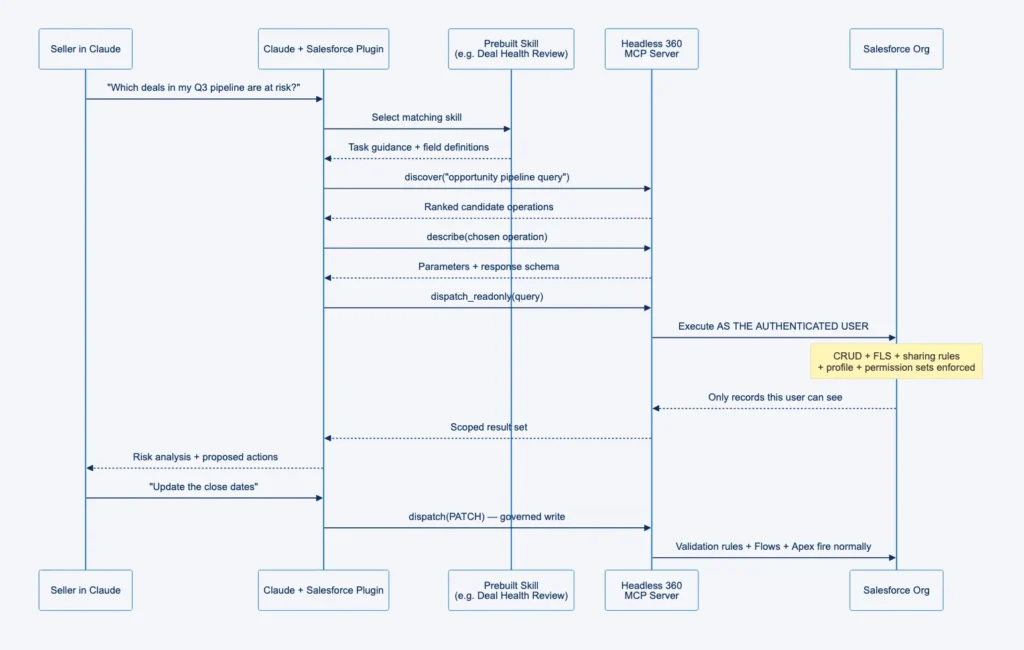
Figure 1: A single request through the Salesforce in Claude plugin. Note that the permission check happens in the org, not in Claude.
Important: that’s the MCP path, not the only path
Here’s the distinction that will bite someone, because the two connection routes have genuinely different security postures and the marketing doesn’t separate them.
Salesforce Hosted MCP Servers (what Salesforce in Claude is built on) use per-user OAuth through an External Client App with the mcp_api scope. Every call runs as the person making it. That’s the model described above.
Claude Tag’s Salesforce connection — the Slack-based route — works differently. Per Anthropic’s documentation, it uses the OAuth 2.0 client credentials flow with a dedicated integration user set as the connected app’s run-as user. Anthropic states it plainly: the credential belongs to the agent, not to any person. Connections live inside an Access bundle, and every request in that bundle’s scope runs as that one integration user.
Best Practices and Gotchas
Audit permissions before you pilot, not after. Covered above and worth repeating — this is the single highest-value prep step. Over-provisioned profiles that were harmless behind a slow UI become genuinely risky behind an agent.
Budget for tokens, and expect uncertainty. Pricing here is consumption-based, tied to API calls rather than seats, and you contract with Anthropic separately for Claude inference. Stokes’s own framing was measured: token consumption “is certainly not zero, but it is nowhere close to approaching the amount of consumption that you would find in a development use case.” That’s a comparison to coding agents, which are the most token-hungry workload there is. It is not a promise that this is cheap. Instrument a pilot cohort and get your own number before you sign anything org-wide.
Start read-only. The recommended pattern is a Permission Set scoped to specific objects and fields, read-only to begin. dispatch_readonly exists precisely so you can enable analysis without enabling writes. Add write access per skill, deliberately, once you’ve watched what the agent actually does.
Remember that writes still hit your automation. A dispatch PATCH is a normal Salesforce write. Validation rules fire, Flows fire, Apex triggers fire, and your CPU-time governor limits apply exactly as they always have. An agent that bulk-updates 200 opportunities will trip the same limits a Data Loader job would. This catches teams who mentally file “AI action” as something separate from “DML.”
Don’t skip the MCP registry question. If you let individual teams stand up their own MCP connections alongside the official plugin, you’ve reinvented shadow IT with better branding. Decide who governs the connector list before the first pilot expands.
Beta means beta. The platform/headless-360 MCP server is Beta. The Salesforce in Claude plugin is pilot-only today. Claude Tag is public beta. Salesforce API v67.0 or later is required for the MCP server. Don’t put a Q4 revenue process on this critical path.
Sequence this against Winter ’27, because the calendars collide. Winter ’27 introduces API version 68.0, and the release notes went live 19 August 2026. Preview instance sandboxes upgrade 28–29 August 2026 — that’s this week — with production waves on 4 September, 2 October, and 9 October 2026.
Two things follow from that. First, v68.0 clears the v67.0+ floor the Hosted MCP Servers need, so a Winter ’27 org is a fine place to pilot. Second, Claudeforce’s open beta (September 2026) lands right on top of your Winter ’27 production upgrade window. Running an AI pilot and a platform release through the same sandbox in the same fortnight is how you end up unable to tell which change broke what. Stagger them. Winter ’27 also expands Agentforce interoperability through MCP more broadly, so the two tracks are related — but “related” is a reason to sequence carefully, not to merge them. (Our Winter ’27 release guide has the full date breakdown if you’re planning the upgrade.)
Watch the concentration risk. Salesforce has made a supplier’s model the default across its product line while becoming a feature inside that supplier’s product. That’s a deep mutual dependency. It’s probably fine. But if you’re an architect writing a five-year platform strategy, note it and keep your model-optionality escape hatch — Agent Builder’s model picker — genuinely exercised rather than theoretical.
Availability and Timeline
| Component | Status as of 27 Aug 2026 |
|---|---|
| Salesforce in Claude plugin | Select pilot customers |
| Claude Tag (incl. Salesforce connection) | Public beta |
| Winter ’27 / API v68.0 | Notes live 19 Aug; preview sandboxes 28–29 Aug; production 4 Sept, 2 Oct, 9 Oct 2026 |
| Open beta | Expected September 2026 |
| Additional prebuilt skills (beyond sales) | Late 2026 — see note below |
| Claude in Atlas Reasoning Engine / Agent Builder | Available |
| Claude in Agentforce Vibes / Coworker | Default |
| Claude as Slack default (Slackbot, Claude Tag, Slack Code) | Rolling out |
platform/headless-360 MCP Server | Beta (since July 2026), API v67.0+ |