
CPQ, or Configure, Price, and Quote, sits at the center of the quote-to-cash process and shapes how a sales organization turns product demand into a valid quote. When the process is well designed, it gives teams a repeatable way to configure products, apply pricing rules, and route quotes through the right approvals. When it is not, teams often fall back on spreadsheets, manual checks, and disconnected documents to fill the gaps.
What makes CPQ difficult is not just the business logic, but the fact that a single quote might need a pricing rule to check a customer’s contract history, a workflow step to route around a missing approver, and a handoff to a billing system that doesn’t recognize the discount code — all before the seller can send a number to the customer. A CPQ system has to interpret what the customer is trying to buy, determine which product and pricing rules apply, and coordinate the next steps across downstream systems and teams. That makes CPQ as much a software design problem as a sales process problem.
In this article, I will explore how an agentic orchestration model can make CPQ more governed and adaptable.
2. Why CPQ Needs an Agentic Model
The CPQ lifecycle is complex because it sits between imperfect customer requests and rigid system constraints. Sellers often work through long RFPs that do not align cleanly with the product catalog maintained inside the organization. At the same time, pricing rules are rarely simple. A strategic account might be entitled to a rate a standard deal never sees, a bundle discount might not map cleanly to list price, and a renewal might carry contract terms that override the default policy entirely.
That complexity is one reason CPQ work frequently spills outside the system into spreadsheets, email threads, and offline documents. Once that happens, the CPQ platform loses visibility into the full transaction context, and the system becomes less effective as a source of truth.
Traditional workflow engines and rule systems also fall short when they are treated primarily as rigid validation layers: they either accept a valid input or raise a hard exception when the input does not match a predefined path.
One recurring pattern I have seen at an enterprise client: when a seller cannot get the discount they need within the system’s rigid rules, they rush to close the deal outside the system, getting the exception approved over email or chat instead. Later, someone tries to sync that data back into the CPQ process, but it rarely goes cleanly. The rules and constraints are still there — closing the deal outside the system doesn’t take them away. It actually defeats the purpose of the whole system. Those rules exist to keep data clean so the CPQ process can be trusted, and when deals happen outside the system and the data is forced back in afterward, that purpose is undermined. Over time, the system ends up running on bad data, and it becomes unusable.
At large enterprise clients, a meaningful share of deal volume runs through processes like this. Many quotes are either handled outside the system or sit unattended within it, as sellers lose interest in using it. So building a genuine enterprise system is not just about the technology or fulfilling user requirements — it’s also about making sure the system actually gets used by the people it’s built for.
An agentic orchestration model can help by handling the standard path automatically and escalating only when the request falls outside policy or requires human judgment. In such a model, specialized agents can support different steps in the lifecycle: a configuration agent can assemble the quote, a pricing agent can apply rules within defined boundaries, an approval agent can auto-approve standard cases and route exceptions through the right chain, a legal agent can enforce contract language, and a revenue validation agent can verify the quote before it moves downstream.
3. What “Agentic CPQ Lifecycle” Means
By an agentic CPQ lifecycle, I mean a CPQ process that is orchestrated by agents from RFP intake through quote handoff to downstream fulfillment, with minimal human intervention on the standard path. Humans are still part of the process, but they intervene only when the request falls outside predefined rules, confidence thresholds, or approval boundaries. The goal is not to remove people from the workflow, but to reserve human judgment for exceptions that truly need it.
This is different from a chatbot-style experience where an agent suggests next steps and a human carries them out. In an agentic CPQ model, the agents themselves execute the work inside enterprise rules and guardrails, with validation, logging, and escalation built into the workflow. That means the system is not just assisting a seller; it is executing the quote-to-cash workflow as a governed automation layer.
The lifecycle stages I am focusing on are product configuration, pricing, approvals, quote document generation, and revenue operations handoff. In practice, that means agents can assemble a valid configuration, apply pricing within policy boundaries, route nonstandard deals through the right approval chain, generate the quote artifact, and pass the result into the fulfillment pipeline. The value is in speed, consistency, and control: routine deals move faster, while exceptions remain auditable and governed.
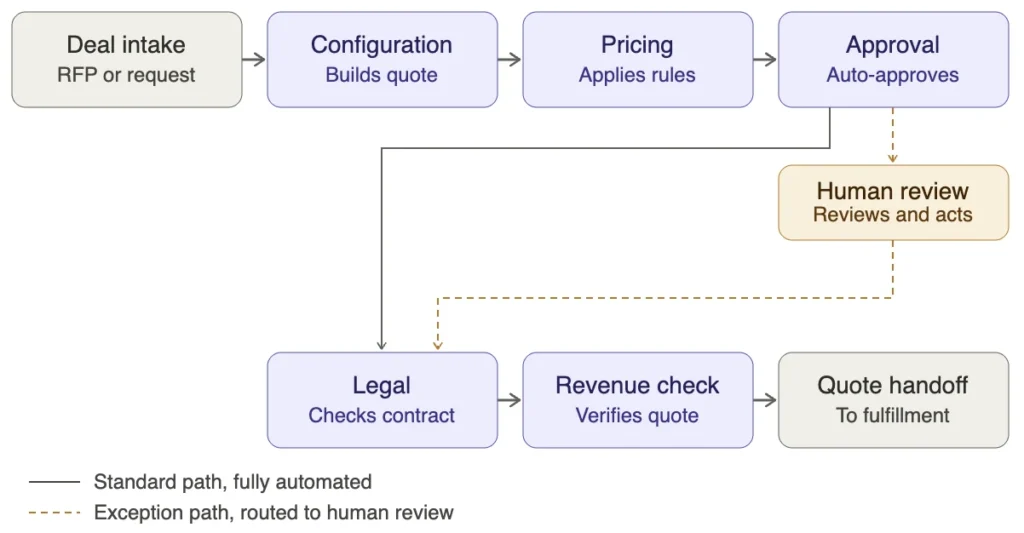
Figure 1: The agentic CPQ lifecycle. Purple boxes are agents acting autonomously within policy; the amber box is where a human steps in on exceptions.
4. A Multi-Agent Architecture for Quote-to-Contract
To make this lifecycle work in practice, I think about it as five specialized agents rather than one general-purpose agent trying to do everything: a Product Configuration Agent, a Pricing Agent, an Approval Agent, a Legal Agent, and a Revenue Check Agent. Each one owns a narrow domain, with its own guardrails defining exactly what it can execute on its own and when it has to stop and hand off to a person.
The Product Configuration Agent starts by pulling customer requirements out of unstructured sources — RFP documents, emails, call transcripts — and mapping them to the product catalog. When there’s a clean match, it configures the quote on its own. When there isn’t, rather than guessing, it surfaces good, better, and best options for a sales rep to choose from, which keeps human judgment where it actually matters instead of asking a rep to interpret the catalog line by line.
Once products are configured, the Pricing Agent works through the pricing rules — customer-specific rates, volume discounts, promotional tiers, price guardrails, the full list-to-net calculation — to keep the proposed price inside policy. If a request would breach a guardrail, like a discount deep enough to require sign-off, the agent stops and hands the exception to the Approval Agent for review rather than pushing it through.
The Approval Agent handles internal governance. A deal that stays within pre-approved pricing and business guardrails advances automatically. One that doesn’t gets routed to the right approvers, and where a deal needs more than one sign-off — Finance, Legal, an executive — those approvals can run in parallel instead of forcing the deal through a sequential queue.
The Legal Agent takes over once commercial terms are set, assembling contracts from a controlled library of pre-approved clauses and templates. It doesn’t write new legal language; it operates strictly inside the boundaries of that library, which is what keeps automated drafting compatible with legal governance rather than working around it.
Last, the Revenue Check Agent performs a final structural check before the quote goes out — confirming billing schedules, revenue recognition codes, and provisioning attributes are complete, and optionally running a dry run against ERP, order management, and provisioning systems to catch execution problems before the contract is signed rather than after.
Why five agents instead of one that handles everything? Mostly separation of concerns. A single agent covering configuration, pricing, approvals, legal, and revenue validation would need an enormous system prompt, and its decision paths would get harder to govern as the business rules underneath it change. Splitting the work means pricing policy can evolve without retesting the legal agent, legal language can change without touching product configuration, and each agent carries its own permissions and guardrails — which makes it much clearer where autonomy ends and a person needs to step in. The goal isn’t five separate bots; it’s five narrow capabilities coordinating as one process.
None of this works, though, if the state lives only in each agent’s own memory. The Salesforce Quote, Opportunity, and Contract records need to stay the single source of truth, with every agent reading from and writing to those structured fields directly rather than passing context conversationally between agents. Transitions between agents run on event-driven triggers — Flow, record status changes — and the process isn’t strictly linear: if the Legal Agent agrees to a non-standard payment term that changes net pricing, that should loop back automatically to the Pricing and Revenue Check agents to re-validate before anything executes.
That same design also does double duty as a security boundary. Each agent’s permissions should be scoped on a need-to-know basis — access only to the objects, fields, classes, and flows its own job actually requires, nothing more. The Pricing Agent has no reason to touch a Contract record, so it shouldn’t have permission to; the Product Configuration Agent has no reason to see approval history, so it shouldn’t either. And because agents communicate asynchronously through events rather than calling each other directly, no agent ever depends on trusting another agent’s raw output — each one reads what it needs straight from the shared records (Quote, Quote Line, Opportunity, Account) and writes its own result back there. That keeps every agent’s blast radius contained to its own domain: even if one agent misbehaves, it can’t reach data or actions outside what its own narrow permission set allows.
None of this needs to be built from scratch on the Salesforce platform. Agentforce Revenue Management, formerly Revenue Cloud, provides native revenue and quoting capabilities that can be extended for specific business rules. Agentforce provides the framework for building domain-specific agents themselves, with custom instructions, guardrail policies, and Apex or Flow invocable actions doing the real work underneath. The platform also provides native quoting capabilities that can give teams a head start rather than requiring them to build the entire quoting experience from scratch.
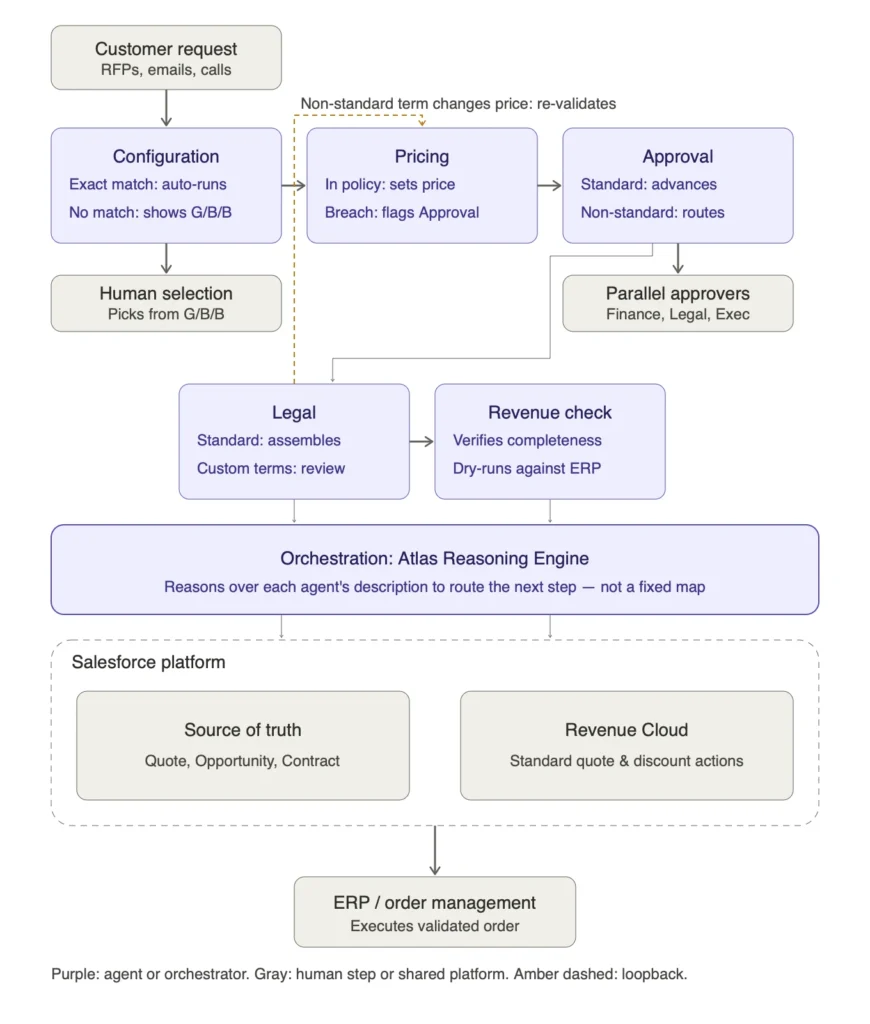
Figure 2: Multi-Agent reference architecture.
5. Guardrails: Keeping Agents Inside Policy
Guardrails are the key to this architecture. Without them, an agent can’t actually perform its role — a guardrail isn’t just a boundary on what an agent shouldn’t do, it’s also what defines what an agent can do. In Salesforce Agentforce terms, this maps closely to instructions: the explicit policy that tells an agent what’s within its authority.
Take a real case: a salesperson is working on an amendment quote for a commercial customer in Asia, cross-selling into an existing deal and offering a discount. When they submit it, the Pricing Agent calculates the discount and checks it against policy — and the policy isn’t just a single discount number, it’s a combination of factors. Because this is an amendment, it’s in Asia, it’s a commercial customer, and the discount offered is deep enough to cross the finance threshold for that specific combination, the Pricing Agent marks the quote as an exception rather than finalizing it. Its instruction is essentially “flag this for approval and hand off, don’t proceed.” The Approval Agent reads that flag, confirms the salesperson can’t approve this on their own, and routes the quote automatically to the Finance VP for Asia, who has to approve it before the deal can move forward. Had the discount stayed under that same threshold, none of that would have triggered — the Pricing Agent would have applied it directly, the Approval Agent would have found no exception to act on, and the quote would have gone straight to the Legal Agent, with no person touching it at all.
That’s the trade-off worth naming: guardrails like this can be expressed as agent instructions, which are fast to configure and adjust, but they are only as reliable as the agent’s adherence to them. That is why real deployments should also pair important business thresholds with hard validation on the record itself, so a quote can’t be finalized past the threshold even if an agent mis-reasons. And every one of these decisions — auto-cleared or escalated — needs to be logged and traceable: not because anything went wrong, but because a routing decision made automatically across region, deal type, and customer segment has to be auditable after the fact, and it’s the pattern across those logs that shows whether a threshold like this one is still set correctly as the business evolves.
Not every guardrail belongs in an agent’s instructions, though. Some rules are simple and absolute — a discount can never go below a legal minimum, a contract can never extend past a fiscal year-end. For rules like that, you don’t need an agent to interpret them correctly every time. You need a Flow or a validation rule that can’t be talked past. Deterministic automation is the right choice when a rule is binary, when getting it wrong even once is unacceptable, or when the volume is high enough that small mistakes add up fast. Agent judgment earns its place on the other side of that line — when a decision depends on weighing several factors together, like the amendment, Asia, commercial customer, and discount combination in this piece. A fixed if/then tree either can’t handle that kind of variation, or it grows too complex trying to cover every combination in advance.
6. Human-in-the-Loop: Where People Still Matter
The goal of autonomous agents isn’t to replace people — it’s to give them back their judgment for the moments that actually need it. In this architecture, people show up in three distinct roles, not just as a catch-all for whatever the agents can’t handle.
The first is exception approval, which is the role we’ve already seen play out. A discount that crosses the finance threshold routes to the Finance VP, as in the Asia deal in Sections 5 and 7; a request that doesn’t cleanly match anything in the catalog puts good, better, and best options in front of a sales rep instead of guessing, as the Product Configuration Agent does in Section 4. In both cases, the human isn’t reviewing everything the agent did — just the one decision the agent couldn’t make on its own.
The second role is auditing the agents themselves, separate from any single deal, and at most organizations this sits with the RevOps team. Someone needs to own each agent’s performance over time, against metrics that actually reflect a CPQ process rather than a generic AI benchmark. The exact set will vary by organization, but a reasonable starting list looks like this:
- Match accuracy: whether the agent maps a request to the right product, price, or approver without a human having to correct it.
- Discount accuracy: whether pricing stays within guardrails without needing a downstream fix.
- Escalation accuracy: whether exceptions that genuinely need a human actually get flagged, and routine deals don’t get flagged unnecessarily.
- Quote cycle time: how long it takes a request to become a finalized quote.
- Approval SLA adherence: whether an escalated exception actually gets resolved within the time the business expects, not just handed off and forgotten.
For the Product Configuration Agent from Section 4, that turns into a concrete illustrative target RevOps can use to evaluate performance: for example, automatically mapping at least 99% of requested items to the product catalog while maintaining a 0% false-match rate, and routing the remaining unmatched cases to a human reviewer alongside the good, better, and best recommendations described earlier. The exact threshold should be established based on the organization’s risk tolerance, data quality, and business requirements. The important point is that “monitor the agent” becomes something RevOps can actually measure over time — this is ongoing oversight, not a one-time check, since an agent that hits these numbers at launch can still drift as the business changes underneath it.
The third role is policy tuning, typically owned by a RevOps admin, and it’s what closes the loop.
Whenever an agent’s autonomy breaks — whenever a request gets escalated instead of handled automatically — that escalation needs to be traceable back to why. If it happened because the request genuinely fell outside a defined guardrail, exactly as designed, no action is needed; the system worked as intended. But if it happened because of something the agent’s instructions simply didn’t anticipate — an edge case, a new deal pattern, a scenario the policy never accounted for — that’s a signal the instructions themselves need to be refined, so the same kind of request can be handled autonomously the next time.
Without this step, every new pattern just becomes a permanent exception, and the system’s autonomy shrinks over time instead of growing.
7. A Deal Walkthrough
The following is an illustrative scenario built to show how the pieces of this architecture interact — not a record of an actual client incident.
Here’s the same Asia amendment deal from Section 5, followed end to end.
A salesperson is working on an amendment quote for a commercial customer in Asia — the customer already has Sales Cloud, and the rep is cross-selling Marketing Cloud into the existing deal, offering a 7% discount. The Product Configuration Agent assembles the quote, adding the Marketing Cloud line alongside the existing Sales Cloud contract. The Pricing Agent then calculates the discount and checks it against policy: for this specific combination — amendment, Asia, commercial — anything above 5% is outside standard authority. 7% crosses that line, so the Pricing Agent flags the quote as an exception instead of finalizing it, and hands it off to the Approval Agent, which reads the flag and routes the quote to the Finance VP for Asia.
The VP reviews it and doesn’t approve 7% outright — they counter at 6.5% and send the quote back. The salesperson resubmits at 6.5%. That number is still above the 5% threshold, so it’s still technically an exception.
This is where the governance design matters.
Smart Approvals are designed to reduce unnecessary re-approval during resubmissions by comparing the current approval conditions with the prior submission. Depending on the approval conditions and their logic, a previously satisfied condition may not require another manual approval when the resubmitted record still satisfies the relevant condition. That behavior is useful for reducing unnecessary approval friction, but it also means that the approval condition itself must capture the business decision that actually needs to be revalidated.
In this example, the business requirement is more specific than simply determining whether the discount is above 5%. The requirement is that the Finance VP must explicitly approve the specific discount value that will move forward. If the workflow does not preserve that exact approved value as part of the validation, a resubmission at 6.5% could potentially satisfy the same threshold condition without establishing that the VP explicitly approved 6.5%.
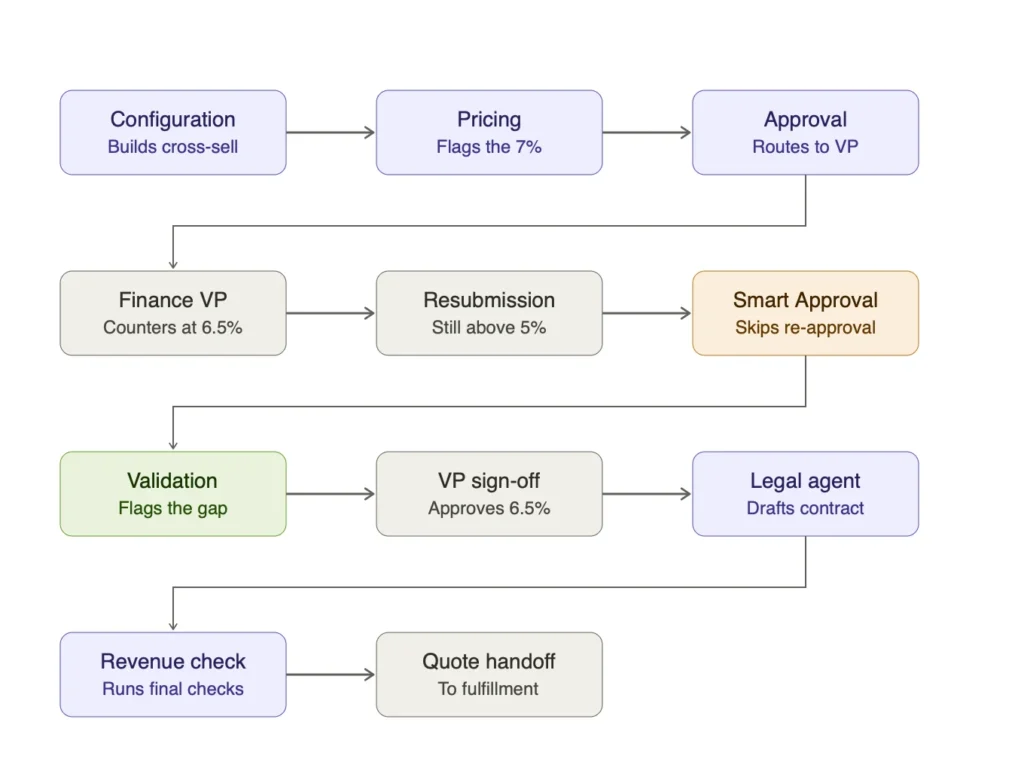
Figure 3: The full path this deal takes, including the near-miss at Smart Approval, the validation check that catches it, and the Revenue check agent’s final verification before fulfillment.
What catches this is the same kind of hard validation rule discussed earlier: before the quote can transition to a status that Legal can act on, a check compares the specific discount value on the record against the value the VP is on record as having approved. 6.5% doesn’t match anything the VP formally signed off on, so the transition is blocked and the quote is routed back for an explicit approval — not a counter-offer this time, but a real sign-off on 6.5% as an authorized exception. The VP approves it, and only then does the quote move forward.
From there, the Legal Agent takes over, drafting the amendment contract from the pre-approved clause library, reflecting the Marketing Cloud cross-sell and the approved 6.5% discount.
Before the quote goes out, the Revenue Check Agent runs a final structural check — confirming the billing schedule, revenue recognition codes, and provisioning attributes are complete for the new Marketing Cloud line, and running a dry run against order management to catch anything that would fail at execution rather than after the contract is signed. Only once that passes does the quote move into fulfillment.
8. Conclusion
None of this is about making CPQ move faster for its own sake. It’s about making the fast path trustworthy enough that a business can actually rely on it — routine deals clearing on their own, in policy, with nothing waiting in a rep’s inbox for a signature, while the deals that genuinely need a person get to the right person with the context of why they’re there.
The Asia amendment deal in this piece is a small example, but the pattern holds at scale: five narrow agents, each governed by its own guardrails, handing a quote to the next only when it’s actually ready, and stopping the moment it isn’t.
The guardrails and instructions this piece describes aren’t a fixed system, though. As the deal walkthrough shows, they’re only as good as how closely they’re watched — and every escalation, every near-miss, is an opportunity to make the next version tighter. That’s the direction I think this goes: not agents that need less oversight because the oversight stopped, but agents that need less oversight because the oversight already found and closed the gaps.
A system’s autonomy should grow the same way trust does — earned one traceable decision at a time.
If you’re building something like this on Agentforce Revenue Management and Agentforce, I’d like to hear what guardrails you’ve had to write, and what’s slipped through them.