
For years, Configure‑Price‑Quote (CPQ) systems have been the backbone of B2B
sales automation. They enforced pricing rules, ensured product compatibility, and sped
up quote generation. But despite these gains, traditional CPQ still suffers from a
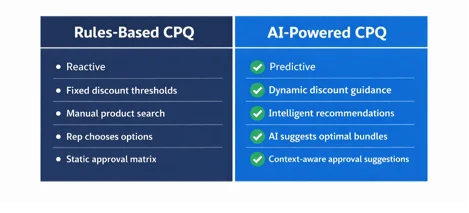
fundamental limitation: it is reactive. It waits for a rep to click through menus, select
options, and apply discounts—often resulting in missed opportunities, suboptimal
pricing, and slow sales cycles.
Enter AI‑powered CPQ. By embedding machine learning (ML) and generative AI into
the quoting workflow, organizations are shifting from rigid, rules‑based configuration to
intelligent, predictive selling. This article explores how AI is transforming CPQ, the use
cases delivering the highest impact, and a practical roadmap for implementation.
The Industry Problem: Why Rules‑Based CPQ Isn’t Enough
Traditional CPQ solved the problem of “spreadsheet chaos” by enforcing product rules
and approval matrices. However, as product portfolios expand and customer
expectations for personalization rise, three persistent challenges remain:
- SKU Explosion – Reps face thousands of products, bundles, and options. Even with
guided selling, they often miss high‑value cross‑sell opportunities. - Inefficient Discounting – Discount approval workflows are binary (approve/deny)
and lack context. A request for 20% off on a strategic deal may be rejected simply
because it exceeds a static threshold. - Manual Data Entry – Reps still spend minutes per quote manually selecting fields
that could be predicted from past behavior or opportunity data.
AI addresses these issues by learning from historical data and injecting intelligence
directly into the quoting interface.
Key AI Use Cases in CPQ
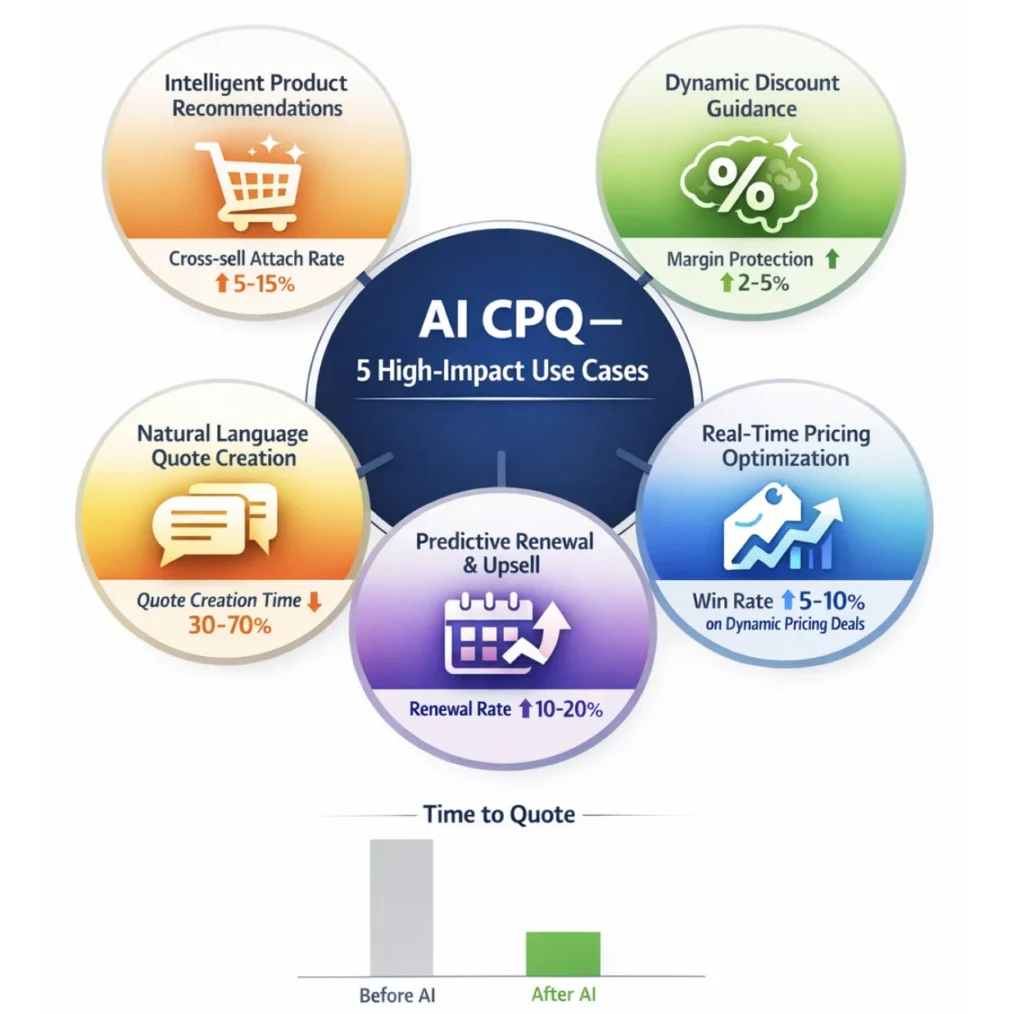
- Intelligent Product Recommendations: AI models analyze closed‑won opportunities to identify patterns—e.g., “customers who buy Product A almost always add Product B within 90 days.” In the CPQ quote line editor, the system surfaces these recommendations in real‑time, turning every quote into an upsell opportunity.
- Dynamic Discount Guidance: Instead of hard approval limits, a regression model predicts the discount level that maximizes win probability while protecting margin. When a rep applies a discount, the AI flags whether the deal is likely to be profitable and suggests an optimal margin range. This shifts the focus from “did you follow the rule?” to “will this deal be successful?”
- Quote‑to‑Cash Automation with NLP: Generative AI (large language models) allows reps to type natural language requests like, “Create a quote for Acme Corp: 3‑year enterprise license for Platform X, with premium support, starting next quarter.”
The AI maps the intent to the correct products, pricing terms, and billing schedule,
auto‑populating the quote line editor and reducing configuration time by up to 70%. - Predictive Renewal and Upsell Identification: By combining CPQ data with CRM activity, AI flags accounts where renewal likelihood is low or where a specific upsell has a high probability of closing. This feeds into sales playbooks and even auto‑generates renewal quotes for rep review.
- Real‑Time Pricing Optimization: In industries with volatile costs or dynamic demand, AI models adjust recommended prices based on market signals, competitor activity, or customer segment—directly within the CPQ pricing engine.
Advantages of an AI‑Augmented CPQ
- Speed – Quote creation time drops from hours to minutes (or seconds with
NLP). - Accuracy – Reduces configuration errors that lead to order cancellations or
fulfillment delays. - Margin Protection – AI prevents excessive discounting by nudging reps
toward optimal price points. - Rep Empowerment – Junior reps sell like top performers because AI guides
them to the best bundles and pricing. - Scalability – Supports hyper‑personalized quotes without expanding sales
operations headcount.
ROI: What to Expect (Without Overpromising)
Organizations that embed AI into CPQ typically report improvements across three
areas:
- Quote cycle time reduction: 30–50% (depending on complexity and adoption)
- Average deal size increase: 5–15% from intelligent cross‑sell and upsell
recommendations - Discount leakage reduction: 2–5% margin improvement as AI‑guided pricing
reduces excessive discounting
These results are realized only when AI models are trained on clean historical data and
when sales teams trust the recommendations.
How AI Integrates with the CPQ Object Model
To understand AI’s impact, it’s important to see how it layers on top of the standard CPQ
data model (using Salesforce CPQ as an example):
| Object | Traditional Role | AI‑Enhanced Role |
| Product | Defines SKU, family, attributes | AI scores products for recommendation relevance |
| Pricebook | Stores list and partner prices | AI generates dynamic price adjustments based on real‑time factors |
| Quote Line | Holds selected products, quantity, discount | AI pre‑populates fields; flags lines with low win probability |
| Option | Defines product constraints | AI suggests optional add‑ons based on similar deals |
| Discount Schedule | Sets approval thresholds | AI overrides with predictive approval recommendations |
| Quote | Container for lines | AI auto‑creates quotes from natural language input |
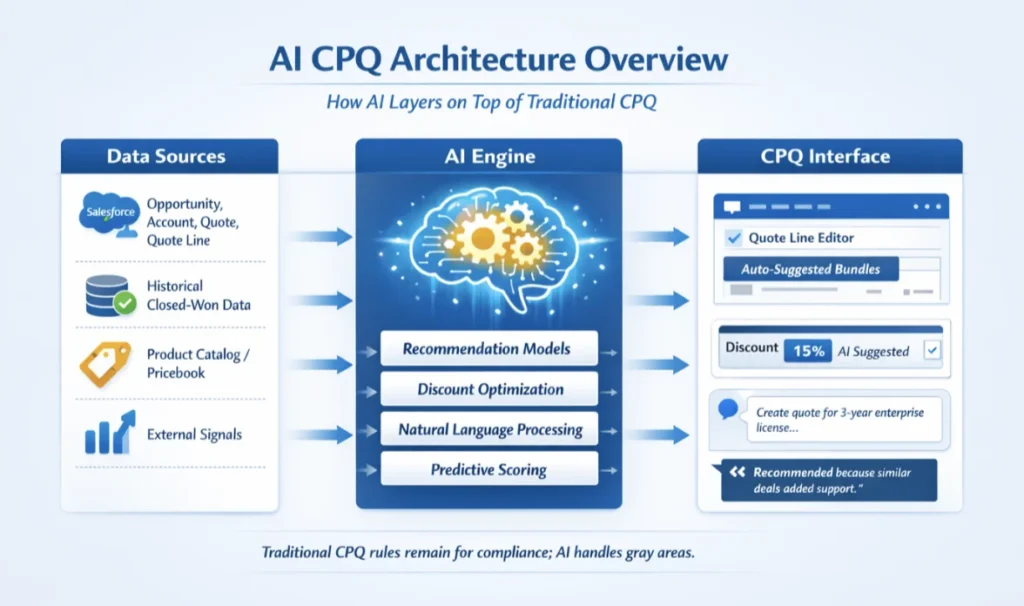
AI models typically reside outside the core CPQ logic (in a data lake or a platform like Einstein AI) but communicate via APIs, webhooks, or native Einstein features. Field mapping becomes critical to ensure that the model receives the right features (e.g., industry, deal size, past purchase history) to make accurate predictions.
Implementation Steps: A Phased Approach
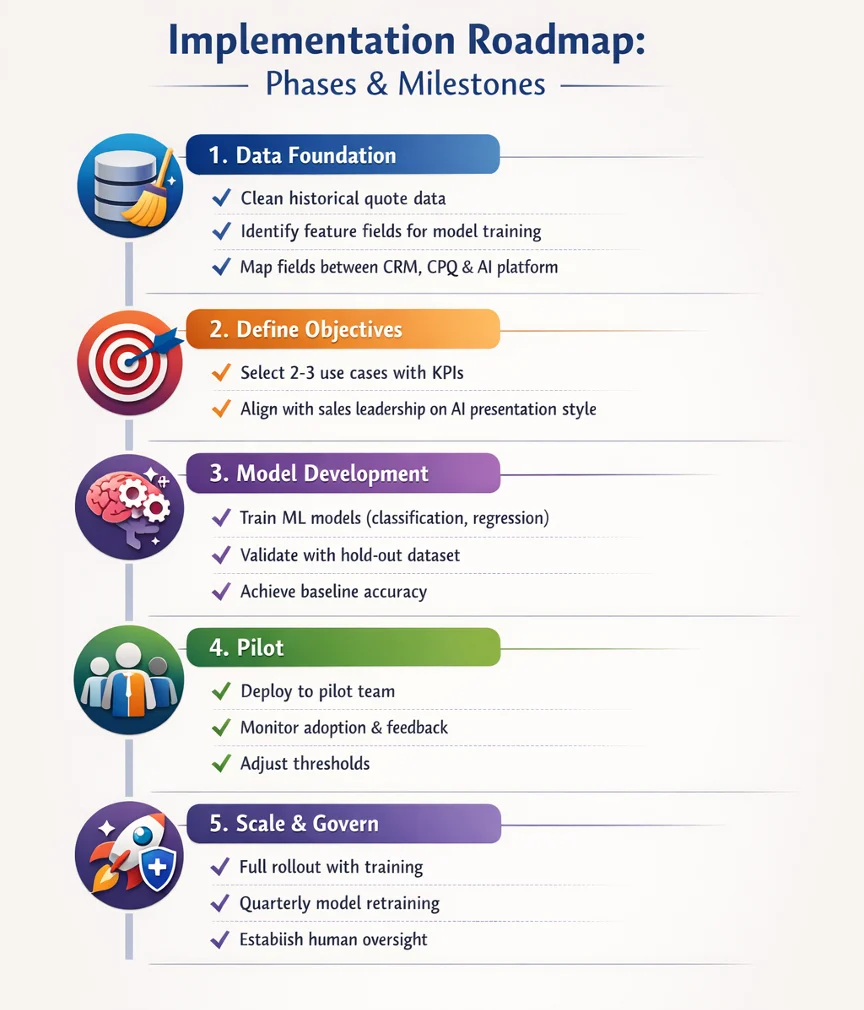
Rolling out AI‑powered CPQ is not a “big bang” event. Use this phased roadmap to manage risk and build momentum.
Phase 1: Data Foundation
- Clean historical quote data – Ensure closed‑won, closed‑lost, and canceled quotes are accurately labeled.
- Identify key fields for model training: product mix, discount levels, sales rep, customer industry, deal size, sales cycle length.
- Map fields between CRM, CPQ, and the AI platform. For example, map `Opportunity.Amount` and `Quote.TotalPrice` to the target variable for pricing models.
Phase 2: Define Business Objectives
- Select 2–3 use cases with clear KPIs (e.g., “increase cross‑sell attach rate on new hardware quotes”).
- Align with sales leadership on how AI recommendations will be presented (e.g., in‑line suggestions vs. mandatory steps).
Phase 3: Model Development & Validation
- Use historical data to train ML models. Common approaches:
- Classification – predict which add‑ons will be accepted.
- Regression – predict optimal discount for a given deal.
- Recommendation systems – collaborative filtering for product bundles.
- Validate models with a hold‑out dataset. Achieve baseline accuracy before moving to pilot.
Phase 4: Pilot with a Sales Team
- Deploy AI insights in a sandbox or with a small group of reps.
- Monitor adoption, feedback, and business impact. Adjust recommendation thresholds based on rep behavior.
Phase 5: Scale & Govern
- Roll out to all sales teams with training focused on “how to use AI as a co‑pilot, not a replacement.”
- Establish a governance process: review model performance quarterly, retrain as product catalogs change, and ensure human oversight for high‑value deals.
Best Practices for AI‑Enabled CPQ
- Start with a narrow scope – Implement one AI use case (e.g., bundle recommendations) and prove value before expanding.
- Maintain a “human in the loop” – AI suggestions should be transparent—show why a recommendation was made so reps can override with confidence.
- Invest in data hygiene – AI models are only as good as the data they are trained on. Inconsistent product names, missing closed‑lost reasons, or duplicate records will degrade performance.
- Align incentives – If reps are measured on margin, they may distrust AI that suggests discounts. Tie success metrics to overall win rate and deal size to encourage adoption.
- Leverage native AI where possible – Platforms like Salesforce Einstein CPQ or Oracle CPQ’s AI services reduce the complexity of custom integrations.
Field Mapping: The Foundation of Model Accuracy
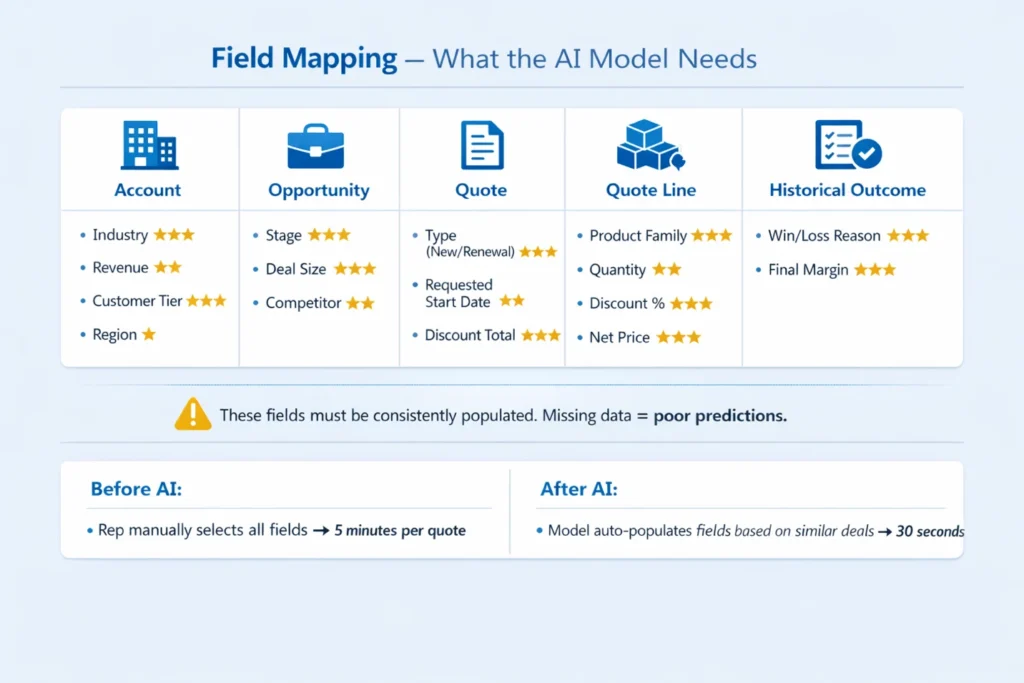
For AI to make meaningful predictions, you must feed it the right fields from your CRM and CPQ objects. A typical feature set for a CPQ AI model might include:
| Field Source | Example Fields | Purpose |
| Account | Industry, revenue, region, customer tier | Customer segmentation |
| Opportunity | Stage, close date, primary competitor, deal size | Deal context |
| Quote | Quote type (new/renewal), requested start date, discount total | Quote behavior |
| Quote Line | Product family, quantity, list price, net price, discount % | Configuration details |
| Historical Outcome | Win/loss reason, final margin | Training labels |
Map these fields into a single dataset for model training. After deployment, the model expects real‑time inputs from the same fields to generate predictions inside the CPQ interface.
Automation & Standardization: The New Balance
Some worry that AI will make CPQ logic obsolete. In reality, AI works best alongside traditional rules. Standardization (e.g., mandatory product features, compliance constraints) should remain rule‑based. AI handles the “gray areas”—where multiple product combinations could work, where discounting is ambiguous, and where rep experience varies. The result is a system that is both reliable (thanks to rules) and intelligent (thanks to AI).
Conclusion: The Future of Quoting
AI‑powered CPQ is not a distant concept—it is already delivering measurable value for early adopters. As LLMs become more integrated with transactional systems, we will see CPQ evolve from a tool that records a quote to one that creates the optimal quote autonomously.
For sales operations leaders, the time to start exploring AI within CPQ is now, starting with clean data and a focused pilot.
Key takeaways:
- AI addresses the limitations of static CPQ by adding prediction, personalization, and automation.
- Start with one high‑impact use case (e.g., product recommendations or dynamic discounting).
- Invest in data mapping and model governance to maintain accuracy and trust.
- Combine AI with traditional rules to balance flexibility with control.
Whether you are on Salesforce CPQ, Oracle, or a homegrown solution, the principles remain the same: let machines handle the complexity so your sellers can focus on the relationship.
About the author
Eshaan Jain serves as a Senior Product Manager at Mphasis, focusing on Revenue Operations and CPQ transformations across Enterprise, Government, and Education sectors. He designs and implements Quote-to-Contract (Q2C) and Contract Lifecycle Management (CLM) platforms. Eshaan earned his MS in Computer Science from the prestigious University of Southern California and has over 13 years of experience with enterprise systems at organizations like Amazon, PwC, and Accenture. He has published research on mobile cloud computing architectures and Artificial Intelligence in leading journals such as IEEE and Elsevier and holds multiple Salesforce certifications. For more insights on AI in the quote-to-cash cycle, product management and Salesforce related content connect with him on LinkedIn.