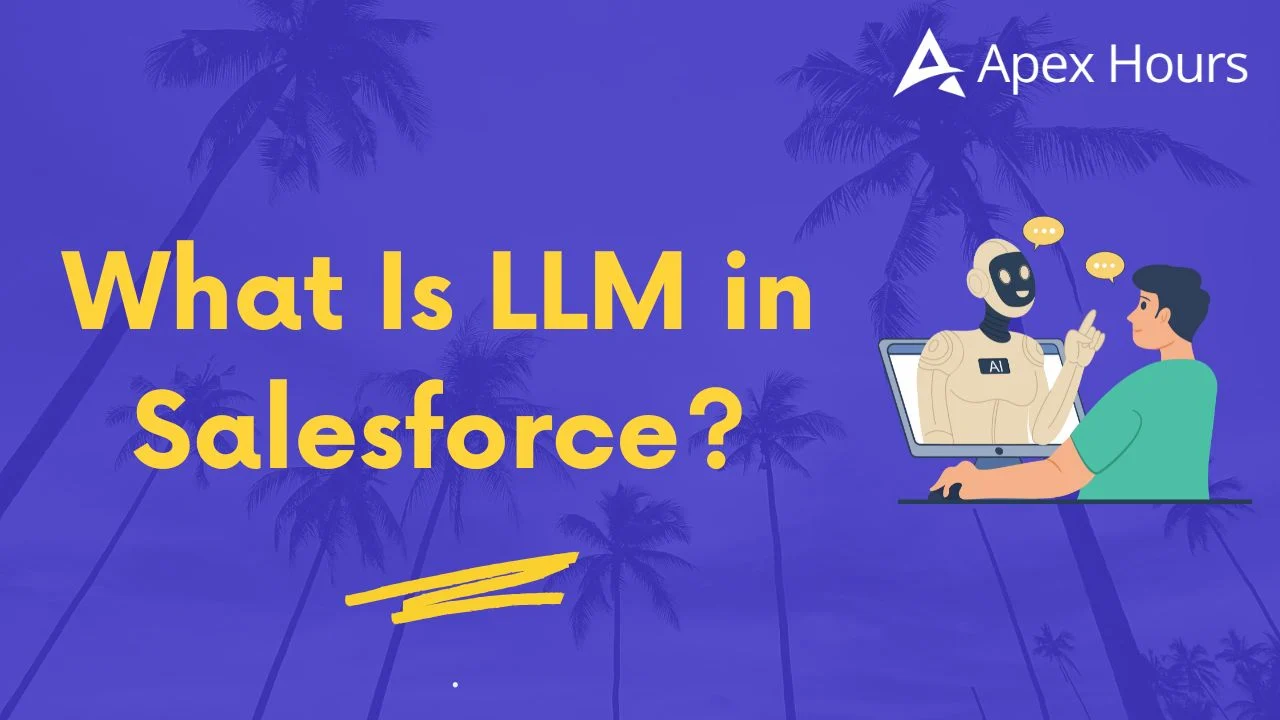

Large Language Models, usually called LLMs, sit at the core of modern AI features in Salesforce. When AI summarizes a case, drafts an email, or answers a customer in plain language, an LLM is doing the work behind the scenes.
But what does that actually mean inside Salesforce?
This article breaks it down clearly. You’ll learn what an LLM is, how it works, how it’s trained, and how Salesforce uses LLMs safely through trusted AI agents. No theory overload. Just what matters and how it fits together.
What Is a Large Language Model (LLM)?
An LLM is a language-focused AI model trained on massive amounts of text. Instead of storing facts like a database, it learns patterns in how language is written and used.
That’s why it can:
- Write complete sentences
- Answer questions in context
- Summarize long documents
- Respond in a human-like way
It doesn’t “know” things the way people do. It predicts what text should come next based on patterns it learned during training.
How LLMs Actually Work
At the most basic level, an LLM predicts text one piece at a time. Each piece is called a token. A token might be a word or part of a word.
When you ask a question, the model:
- Reads the input
- Predicts the next token
- Repeats the process until the response is complete
Three technical ideas make this possible.
Machine Learning and Deep Learning
Machine learning allows the model to find patterns in data. Deep learning takes this further by improving accuracy with minimal human guidance using probabilities instead of fixed rules.
Neural Networks
Neural networks process language through layers of connected nodes. Each layer refines the understanding of the input, helping the model connect words, phrases, and meaning.
Transformer Models
Transformers help the model understand context. Using self-attention, the model evaluates how words relate to each other within a sentence or paragraph. This is why modern AI understands intent, not just keywords.
Why LLMs Are “Large”
The “large” in LLM refers to scale. These models contain billions or even trillions of parameters.
Parameters are the values the model learns during training. More parameters give the model more capacity to understand nuance, tone, and structure. The tradeoff is cost, infrastructure, and the need for strong governance.
How LLMs Are Trained
Training an LLM follows a repeat-and-improve cycle.
- The model reads a sentence
- It guesses the next word
- The guess is checked against the real text
- The model is corrected
- The process repeats at massive scale
After initial training, models are tested on unseen text to ensure they’ve learned patterns instead of memorizing content.
Fine-Tuning Explained Simply
Fine-tuning means training an already-trained model on a smaller, focused dataset.
A general-purpose model might understand language well. Fine-tuning helps it perform better in specific areas like customer service, CRM data, or internal knowledge.
This approach:
- Saves time and cost
- Needs less data
- Delivers better results for targeted use cases
That’s why most organizations fine-tune instead of building models from scratch.
Model Versions and Evolution
New LLM versions usually keep the same core architecture while improving scale, data quality, and alignment.
Each version aims to:
- Handle more complex tasks
- Reduce errors and bias
- Improve reasoning and reliability
Some versions are also fine-tuned for specific purposes, such as speed, cost efficiency, or deeper reasoning.
Common LLM Use Cases
LLMs are used across many business scenarios, including:
- Writing emails and content
- Summarizing documents
- Answering knowledge base questions
- Generating and explaining code
- Analyzing customer sentiment
- Translating languages
- Categorizing and tagging data
- Powering AI agents
This is where LLMs move from experimental to practical.
How Salesforce Uses LLMs
Salesforce embeds LLMs directly into the platform with trust as the foundation.
The Einstein Trust Layer
All generative AI in Salesforce runs through the Einstein Trust Layer.
This layer:
- Masks sensitive data
- Grounds responses using retrieval-augmented generation (RAG)
- Controls data flow to and from models
- Keeps prompts and responses within Salesforce boundaries
This ensures AI remains useful without exposing customer data.
Agentforce and Autonomous AI
Agentforce uses LLMs through the Trust Layer to create AI agents that can act, not just respond.
These agents can:
- Understand natural language requests
- Use Salesforce and Data 360 data securely
- Complete tasks without constant human input
They support service, sales, and operational workflows while staying within enterprise controls.
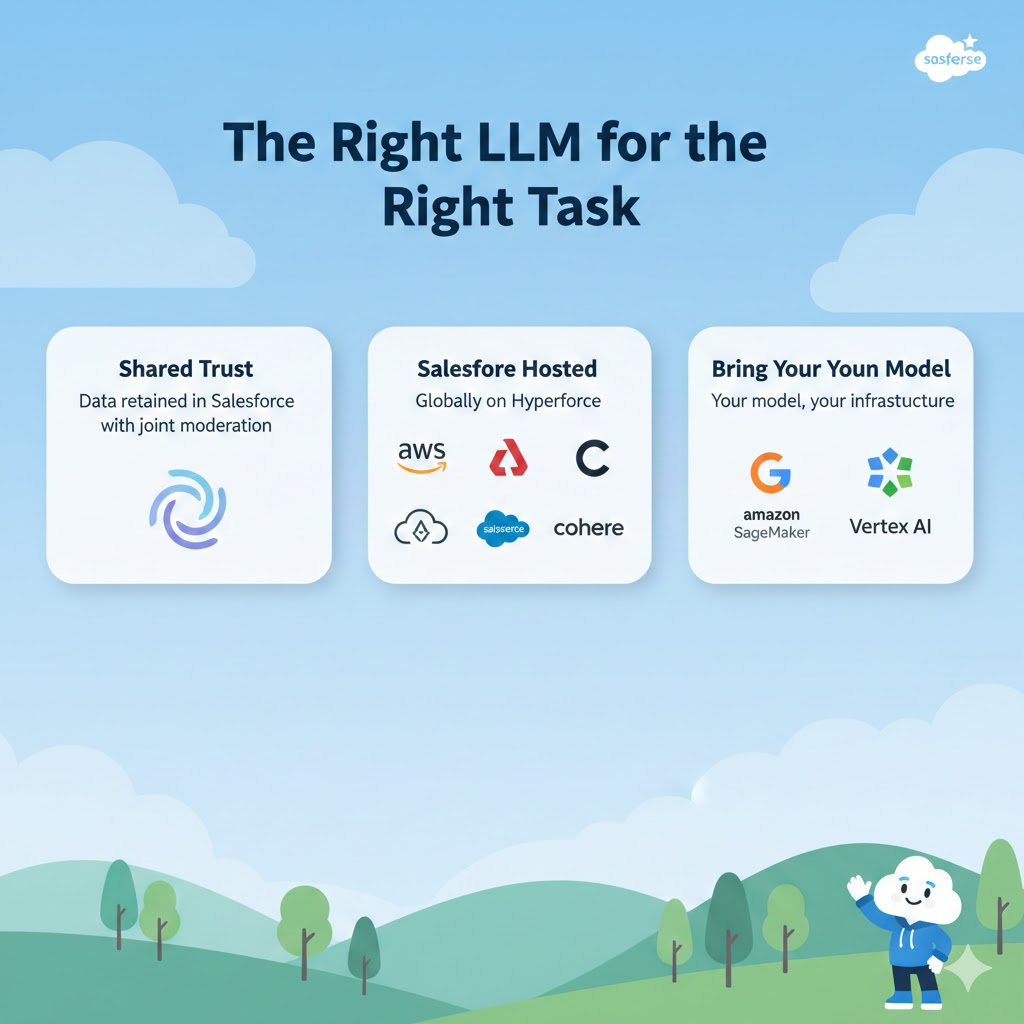
Choosing the Right LLM in Salesforce
Salesforce supports multiple LLM options instead of forcing a single model.
By default, Agentforce uses OpenAI GPT-4o, sometimes through Azure. Beyond that, Salesforce allows:
- Salesforce-managed LLMs
- Salesforce-hosted third-party models
- Bring Your Own Large Language Model (BYOLLM)
Different models can be used for different tasks, all routed through the same trust framework.
Benefits and Limitations of LLMs
Benefits
- Adapt well to natural language
- Flexible across many use cases
- Reduce manual effort
- Improve with more data
Limitations
- High operational cost
- Risk of bias
- Limited explainability
- Possibility of incorrect outputs
- Security concerns without proper controls
These limits explain why governance layers matter.
Conclusion
LLMs change how people interact with software. Instead of clicking through screens, users can express intent in plain language.
Salesforce combines LLMs with trust, grounding, and workflow execution to make this practical at scale. The result is AI that supports people instead of replacing them.
When used responsibly, LLMs don’t automate thinking. They remove friction between intent and action. That’s where real value comes from.